
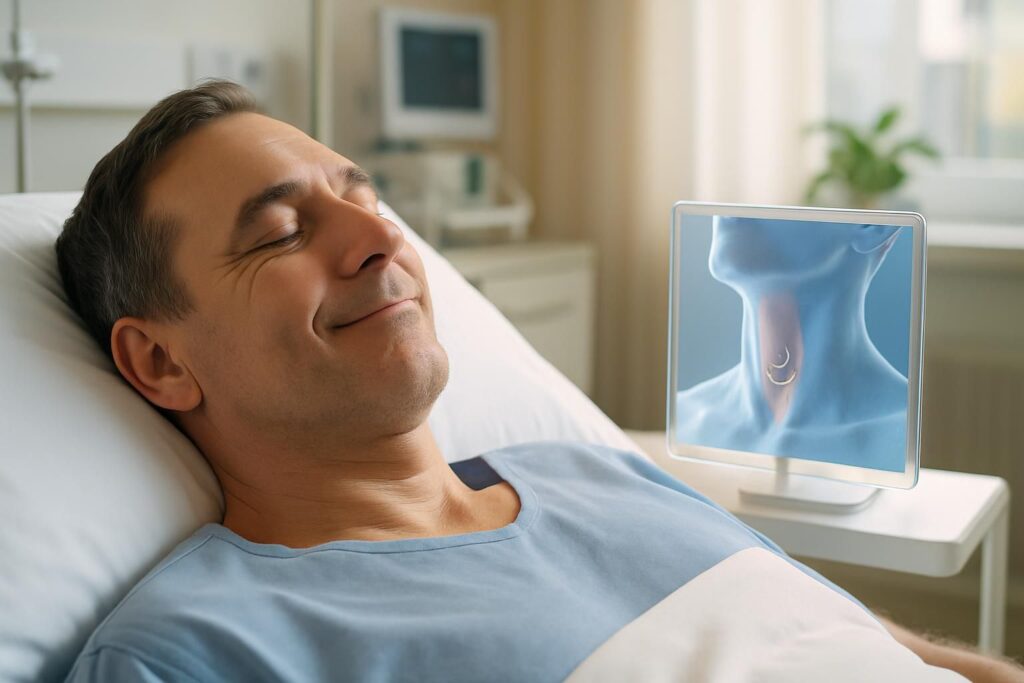
In France, nearly four million people live daily with obstructive sleep apnea, a severe respiratory disorder that disrupts the quality of their rest. The reference treatment for years remains the continuous positive airway pressure (CPAP) mask which, despite its effectiveness, is often rejected by a significant portion of patients due to noise disturbances, discomfort, and various complications related to its use. Starting August 2024, a major breakthrough has occurred: an implantable device called Inspire is now fully reimbursed by the Health Insurance system. Available today in about twenty centers in France, notably at the Reims-Bezannes polyclinic, this “sleep pacemaker” revolutionizes the care of suffering patients, offering an effective treatment that requires neither mask wearing nor daily discomfort.
This new implant acts on a specific nerve, the hypoglossal nerve, through targeted electrical stimulation which automatically clears the upper airways in rhythm with the patient’s breathing. This technological advance embodies an innovative solution, not only in terms of comfort but also medical effectiveness, reinforced by a recent scientific meta-analysis. The phones at the facilities offering the treatment keep ringing, illustrating the strong demand from patients exhausted by previous inadequate methods.
While the comfortable champagne tasting armchair might seem distant from this medical field, it perfectly illustrates how technological innovation, combined with a keen understanding of patient expectations, can significantly improve quality of life, a concern shared both by medical professionals and the patients themselves. The treatment of sleep apnea is thus evolving from a simple artificial respiration system to an active, discreet, and reimbursed therapy, which could truly transform the landscape of sleep care in France.
The limits of the CPAP mask: ongoing suffering among patients with sleep apnea
The continuous positive airway pressure (CPAP) mask has long been the flagship treatment for obstructive sleep apnea. Its principle is based on maintaining a constant air pressure that prevents the closure of the upper airways during sleep. Despite this recognized effectiveness, a significant proportion of patients abandon this treatment due to often profound difficulties in terms of comfort and acceptability.
Patients frequently report several major inconveniences: the masks are often noisy, causing sleep disturbances for the patient as well as their entourage. They also generate intense dry mouth, skin irritations at contact points, and a feeling of oppression which can cause stress and anxiety. These effects are worsened by the need for prolonged and continuous nightly use, generally all night, sometimes from falling asleep until waking.
Let us mention the case of Jean, a fifty-five-year-old patient diagnosed five years ago. He first tried the CPAP mask diligently, but the troubles related to its use quickly discouraged him. The sensation of suffocation and the continuous noise disturbed not only his night but also affected his social life: Jean was afraid to invite relatives or friends to stay overnight, aware of the noise and his discomfort.
In parallel, the frequent abandonment of CPAP results in an absence of treatment against the disease, with heavy long-term consequences. Indeed, without appropriate management, sleep apnea is accompanied by increased risks of hypertension, cardiovascular disorders, strokes, and significant fatigue casting a shadow over overall quality of life. According to specialists, 5% of the French population is affected, a significant proportion that justifies the importance of viable medical alternatives.
These inconveniences lead a large number of patients to seek another better-tolerated solution capable of bringing real relief. It is precisely in this context of prolonged suffering that the Inspire implant finds all its relevance: a new technology offering an alternative respectful of patients’ daily lives.
Presentation of the Inspire implant: an innovative and reimbursed solution for sleep apnea
Since May 2026, the Reims-Bezannes polyclinic has been offering a revolutionary therapy to treat sleep apnea: the Inspire implant, a neuro-electrical stimulation medical device. This “sleep pacemaker” is designed to stimulate the hypoglossal nerve, a key driver in maintaining open airways during the night.
The principle is simple but ingenious: a box the size of a matchbox is implanted just below the clavicle, connected to an electrode positioned in contact with the hypoglossal nerve. In rhythm with breathing, this system sends an impulse that pushes the tongue forward, thus preventing obstruction of the airways. The patient activates the device via a remote control every evening, without using a mask or bulky accessories.
This new therapeutic option primarily targets patients for whom the CPAP mask or mandibular advancement device has failed. The procedure, performed on an outpatient basis under general anesthesia, does not exceed two hours and requires a month of healing before the system activation. Post-operative comfort is notable and the resumption of daily activities rapid.
Inspire innovation is now fully 100% reimbursed by Health Insurance since August 2024, an advance that greatly facilitates patient access. This reimbursement includes both the cost of the implant (estimated at 22,000 euros) and the ancillary costs related to the operation. Dr. Marion Renaud, ENT physician at the polyclinic, emphasizes that this solution not only improves patients’ quality of life but also reduces costs related to untreated apnea complications, which heavily weigh on healthcare expenditures.
Strict eligibility criteria are applied to guarantee maximum benefit: a body mass index below 32, a proven failure of other conservative treatments, and a thorough evaluation by endoscopy under induced sleep. This rigorous protocol offers patients wishing to benefit from this new solution a guarantee of seriousness and safety.
Each week, the polyclinic records strong demand for the implantation of this device, reflecting the high expectation of patients often exhausted by years of suffering and without an appropriate solution.
Clinical and scientific evidence of hypoglossal neurostimulation therapy
Inspire therapy relies on solid scientific evidence strengthened in 2026 by a major meta-analysis published in the journal Sleep and Breathing. This study coordinated by international teams compares the effectiveness of four common treatments for apnea: CPAP, upper airway stimulation (UAS) like the Inspire implant, transoral robotic surgery (TORS) and tissue reduction by plasma ablation (PATBR).
The results of this analysis, covering 758 patients from ten different studies, are unequivocal: stimulation by UAS implant shows marked superiority in reducing the apnea-hypopnea index (AHI) compared to other approaches. The cure rate is multiplied by 12 compared to surgery, when the AHI is brought below the threshold of 5 events per hour, a recognized criterion signaling normalized sleep.
Beyond this clinical effectiveness, the Inspire implant significantly reduces hospitalization times, limiting indirect costs and patient burden. Robotic surgery, more invasive, leads to longer stays and longer recovery periods. On the other hand, regarding daytime sleepiness measured by the Epworth scale, no significant difference was observed between treatments.
Furthermore, several patient feedback reports indicate a tangible improvement in sleep quality and overall well-being: more energy upon waking, decreased morning headaches, and improved cognitive abilities. This contributes to better social and professional integration of treated individuals.
In summary, this new neurostimulation therapy establishes itself as a major medical advance to offer patients a concrete and lasting solution in managing obstructive sleep apnea.
Access to this implantable solution in France: centers, indications, and treatment conditions
Since its reimbursement by the Social Security system, the Inspire implant is offered in about twenty specialized centers in France, including the Reims-Bezannes polyclinic. These establishments have multidisciplinary teams including pulmonologists, ENT surgeons, and sleep specialists, ensuring comprehensive and personalized patient care.
The access pathway to the implant begins with a precise diagnosis and rigorous evaluation of apnea severity. The patient who has abandoned the CPAP mask or for whom it is ineffective is then referred to a thorough assessment, notably including an endoscopy under light anesthesia to observe obstruction during induced sleep. This protocol is essential to confirm eligibility for the implant.
The main indications for this technique are therefore:
- Moderate to severe obstructive sleep apnea according to the apnea-hypopnea index (AHI).
- Failure or poor tolerance of the CPAP mask and mandibular advancement devices.
- Body mass index (BMI) below 32, thus avoiding complications related to severe obesity.
- No major airway anomalies incompatible with implantation (evaluated by endoscopy).
The treatment is then accompanied by regular follow-up to adjust stimulation parameters and ensure proper healing. One month after the operation, the device is activated then optimized according to patient feedback and clinical measurements.
Organizationally, the surgical procedure is relatively short, about two hours, and performed on an outpatient basis. This setup reduces logistical constraints and waiting times.
Thanks to this enhanced availability in the Champagne-Ardenne region and throughout France, many suffering individuals now have a tangible and effective alternative to regain restful sleep, essential to better overall health.
Observed benefits and patient reception of the Inspire implant
Since the availability of the Inspire implant, patient feedback highlights a significant transformation in their quality of life. Testimonials converge: no more discomfort and fear caused by mask wearing, instead a discreet, easy-to-use, and effective solution.
In the case of Béatrice, originally from the Ardennes, the implant felt like a rebirth after years of exhaustion. She describes her nights as finally restful and her chronic fatigue reduced, allowing her to resume daily activities previously out of reach, such as family walks and a more active social life.
Key observed benefits include:
- Notable improvement in sleep quality, with reduced micro-awakenings and more normal breathing over the nights.
- Disappearance of mask-related discomfort, which promotes better treatment acceptance.
- Better daytime alertness and reduced sleepiness, despite sometimes moderate effects on certain tests.
- Reduction of associated risks, especially cardiovascular, linked to untreated sleep apnea.
- Regained independence thanks to simple activation and deactivation of the device, controllable by the patient themselves.
Additionally, the support from medical teams and close follow-up contribute to reassuring care, limiting fears related to surgery and implantation of a foreign body.
Finally, this innovative treatment responds to an increasingly urgent demand for solutions other than the mask, which remains a real obstacle for a large part of patients currently suffering. The success of the Inspire device seems to open a new era in the management of nocturnal respiratory disorders.
What is obstructive sleep apnea?
Obstructive sleep apnea is a disorder characterized by repeated stops in breathing during the night due to narrowing or obstruction of the upper airways. This causes frequent micro-awakenings, poor sleep quality, and various health risks.
Why is the CPAP mask often poorly tolerated?
The CPAP mask, although effective, often causes troubles such as noise disturbance, dry mouth, skin irritation, and general discomfort, leading many patients to abandon it.
How does the Inspire implant work?
The Inspire implant stimulates the hypoglossal nerve to push the tongue forward and clear the airways, allowing normal breathing without a mask during sleep.
Who can benefit from this implantable treatment?
Patients with moderate to severe apnea who do not tolerate the CPAP mask, with a BMI below 32, and having undergone strict evaluation are eligible for the Inspire implant.
Is the Inspire treatment reimbursed?
Yes, since August 2024, the Inspire implant is fully reimbursed by Health Insurance, thus facilitating access to this innovative solution.