
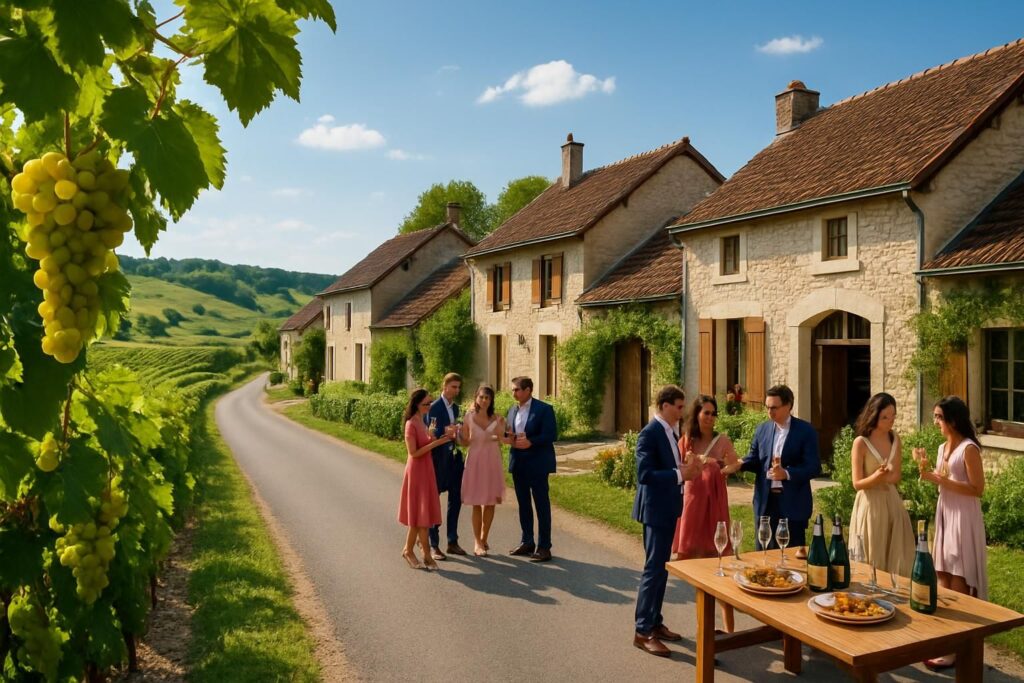
In the heart of the Champagne landscapes, the summer season of 2026 promises to be exceptional with the simultaneous opening of 22 cellars located between Aube and Haute-Marne. This event takes on its full meaning within the framework of the Route du Champagne en Fête, which invites enthusiasts and the curious to unravel the secrets of a renowned terroir. Created in 1995, this wine tourism festival annually brings together a large audience around a living heritage combining traditions, know-how, and conviviality. The massive opening of the cellars in 10 villages on the right bank of the Aube valley allows for embracing the diversity of expressions of Champagne wine, while highlighting the richness of the local vineyard marked by its history and contemporary dynamism.
Visitors are invited to a complete immersion in the world of Champagne, the result of a complex process combining rigorous viticulture and ancestral winemaking techniques. During August 1st and 2nd, the winemakers open their doors to reveal behind-the-scenes aspects of their craft, share their knowledge, and offer carefully orchestrated tastings. This festive moment transcends mere gustatory discovery: it is a vibrant tribute to the passion of the producers and the uniqueness of a terroir that unites Aube and Haute-Marne without artificial borders.
The richness of the cellars open on the Route du Champagne: diversity and terroir
The 22 cellars participating in this edition embody the excellence and diversity of the Champagne vineyard, with a strong concentration on the Côte des Bar. This area is recognized for its clay-limestone soils particularly suited to the cultivation of Pinot Noir, the emblematic grape variety in the making of prestigious cuvées. The plurality of cellars reflects both a variety of sizes, ranging from confidential family structures to more renowned estates, and a palette of Champagnes ranging from traditional classics to more innovative productions.
Each cellar exploits the local geological and microclimatic particularities to offer wines with a strong identity, blending freshness, complexity, and finesse. Some operations base their approach on a sustainable and organic logic, thus promoting respect for the vine and the environment in winemaking. This allows visitors to grasp the full ecological and cultural dimension carried by Champagne.
The tastings allow appreciation not only of the grands crus and premiers crus but also of special cuvées created for the event. The discovery of different winemaking methods, notably concerning malolactic fermentations or aging durations on lees, presents itself as a true initiation into the complexity of Champagne.
A wine tourism journey between encounters, know-how, and festivities
The Route du Champagne en Fête is not limited to a simple tasting; it offers a complete experience focused on the discovery of the viticultural heritage, animated by the winemakers themselves. This direct exchange between producers and visitors contributes to the transmission of a unique expertise shaped over centuries. Beyond tasting the finished product, it is possible to immerse oneself in the key stages of the winemaking process through guided tours, tactile workshops, or demonstrations provided by specialists such as Julie Cavil, cellar master.
A route marked by conviviality and cultural discovery, participants can also enjoy musical entertainment, culinary workshops pairing local dishes and Champagne, and walks through the vineyards to better understand the impact of the terroir. These initiatives reinforce the festive and educational dimension of the event.
The diversity of villages crossed, from Bar-sur-Aube to Colombey-les-Deux-Églises, offers a rich architectural and landscape panorama, revealing the dual identity of Aube and Haute-Marne within the Champagne vineyard itself. The animation of the cellars takes place in settings often steeped in history, further enhancing this impression of harmony between terroir, tradition, and modernity.
The singularities of the terroirs of Aube and Haute-Marne: a complementarity to discover
Often seen as a simple extension of the Champagne vineyard, the terroirs of Aube and Haute-Marne deserve to be considered as complementary entities with a distinct identity. The Côte des Bar, in particular, has exceptional pedoclimatic characteristics, resulting in a very specific expression of Pinot Noir and Chardonnay.
In Aube, clayey and limestone soils confer an elegant structure with intense fruity notes to the wine, while the more northern parcels in Haute-Marne often bring marked freshness and remarkable liveliness. This synergy gives a unique aromatic richness to the Champagnes produced in this region, often little known but deeply rooted in tradition.
The winemakers of both departments work in a spirit of unity around the same vineyard, rejecting administrative boundaries to favor the coherence of the soil work. This spirit is perfectly embodied during the Route du Champagne en Fête, where collaboration between actors of Aube and Haute-Marne celebrates a unified heritage.
Among the notable initiatives, strong involvement in the enhancement of traditional cellars and Champagne subsoils is to be highlighted, essential elements in the quality of wine aging, as emphasized by the exploration of Champagne cellars. These historic infrastructures are treasures of architecture and winemaking history, intrinsically linked to the quality of the final product.
The modern challenges of the vine and winemaking in the Champagne context
Facing challenges related to climate change, the evolution of global markets, and consumers’ quest for authenticity, Champagne viticulture is reinventing itself without losing its roots. The emphasis on the 22 cellars during the Route du Champagne en Fête also highlights the adaptability and technical innovations implemented to sustain this sector of excellence.
Among notable developments are precise irrigation management, rootstock selection, and gradual transition to more reasoned practices, even organic farming, which permanently modify yields but considerably improve grape quality. These actions are accompanied by increased attention to winemaking, on which the finesse of bubbles and the aromatic complexity of Champagne rely.
The key role of cellar masters, like Julie Cavil, is highlighted during this event where technique meets passion. The mastery of fermentations, dosage, and blends reflects the accumulated and renewed expertise generation after generation. This ensures visitors a fine understanding of the product and a memorable tasting experience.
Furthermore, the Route du Champagne is an essential vector in the development of wine tourism, a rapidly growing sector combining discovery, responsible consumption, and enhancement of local heritage. Tastings are frequently accompanied by detailed explanations, inviting the public to apprehend winemaking in its entirety, from grape to bottle. This enthusiasm for cultural and sensory tourism helps make this event a true popular and professional celebration at once.
Participating in the Route du Champagne: practical advice to fully enjoy the event
To make the most of this unique event, it is advisable to carefully prepare your route. Purchasing an access pass, offered around 45 euros, allows for a tasting in each participating cellar while facilitating travel between the different villages. This formula also simplifies the discovery of the diversity of Champagnes produced on the right bank.
It is recommended to favor soft mobility means: bike, carpooling, or organized transport promote responsible and safe consumption. The variety of sites also implies planning breaks to fully enjoy the entertainment, exhibitions, and moments of sharing with the winemakers.
The following list helps optimize your visit:
- Bring a tasting ticket booklet to manage your route.
- Wear comfortable shoes for walks in the vineyards and cellars.
- Do not hesitate to ask questions to the winemakers to enrich your knowledge.
- Alternate tasting with water and food offered on site.
- Take note of favorite cuvées for direct or later purchases.
To deepen the discovery, the mapping of Champagne cellars available on this resource offers a relevant overview. Moreover, cultural experiences around Champagne can complement this wine getaway by visiting emblematic sites and remarkable houses such as those offered in the Champagne lifestyle experiences.
Which villages of Aube and Haute-Marne participate in the Route du Champagne en Fête?
Ten villages located on the right bank of the Aube valley, from Bar-sur-Aube to Colombey-les-Deux-Églises, participate in the event with their 22 cellars open to the public.
How does the winemaking process work in these Champagne cellars?
Winemaking combines traditional and modern techniques, including alcoholic fermentation, often malolactic fermentation, cellar aging, and precise blending orchestrated by cellar masters.
Is it necessary to book to participate in the tastings during the Route du Champagne?
Purchasing an access pass is recommended to guarantee a tasting in each participating cellar. It is often available for pre-sale or on-site depending on the organization’s arrangements.
What types of activities are offered during this event?
Visitors enjoy musical entertainment, culinary workshops, guided tours, and sometimes technical presentations by professionals such as cellar masters.