
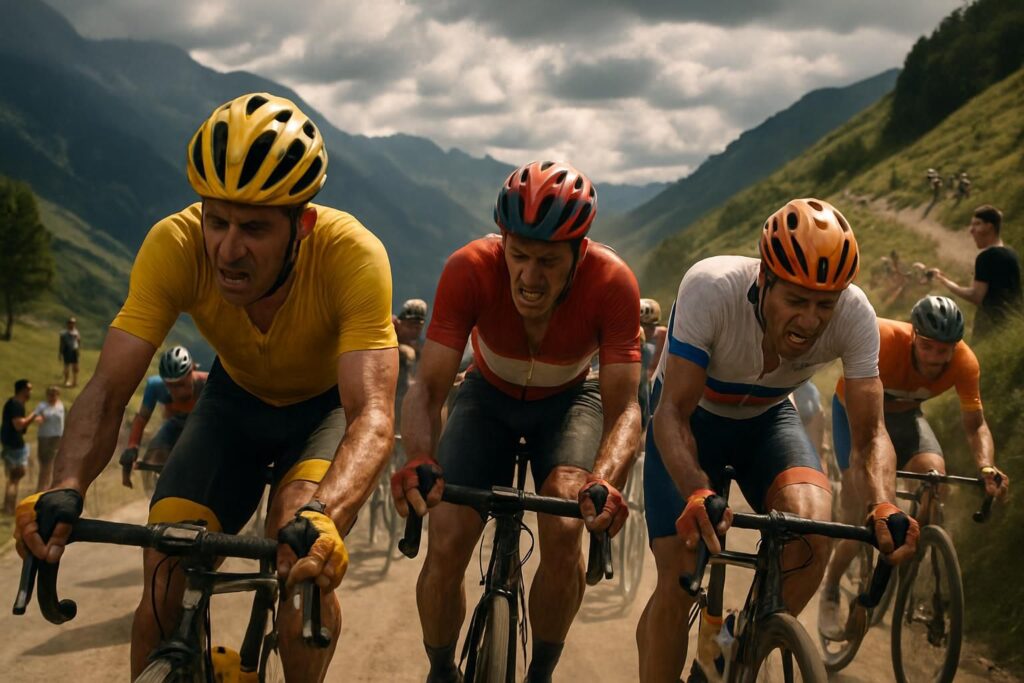
The 113th edition of the Tour de France unfolds under a blazing sky and routes of rare harshness. Throughout the stages, the peloton, usually vibrant with energy, bends under the weight of accumulated fatigue, relentless heat, and an unprecedented race intensity. Each rider now embodies a fight for survival, in a constant struggle against their own physical and mental limits. The prospect of a double climb of Alpe d’Huez sets an ultimate test of endurance and resilience, a challenge that could well make the difference in this exceptional competition.
Drawn faces, declining performances, and rushed withdrawals testify to a championship where exhaustion is more than a trial—it is an omnipresent reality. The peloton’s ardor to maintain a frenetic pace illustrates the extreme nature of this cycling race, where every kilometer is a battle against breakdown. The 2026 Tour thus asserts itself as a theater where survival outweighs ambition and where the upcoming double challenge could seal the fate of many contenders for the final victory.
Widespread fatigue within the peloton: a daily fight from the earliest stages of the 2026 Tour de France
The current edition of the Tour de France has plunged its participants into an endless fight against an invisible but formidable opponent: fatigue. From the start in Barcelona, the heatwave settled in, inflicting on the peloton temperatures often nearing 40 degrees Celsius, an aggravating factor in an already fierce competition. This extreme heat forced the riders to redouble their efforts to maintain a high pace, gradually exhausting their bodies. The peloton quickly found itself in difficulty, with obvious signs of exhaustion, especially during the longest or most mountainous stages.
Testimonies from riders like Kévin Vauquelin, visibly affected after a stage at Orcières-Merlette, clearly illustrate this reality: “I feel awful, I think I’m starting to get sick. It was horrible today, it sucks.” This return to reality from a promising rider highlights the difficulty of continuing a competition where the body no longer keeps up.
This fatigue is not isolated. According to Yvon Ledanois, an experienced sports director, “85% of the riders are wiped out, if not 100%.” A harsh observation that testifies to the extreme burden placed on the peloton. The competition has become a mental and physical survival test, where every day is a race against cramps, dehydration, and breakdowns. This true ordeal continues without real pause, in an edition where the pace does not slacken.
The frenzied intensity of the early hours has left little room for recovery. The peloton is subjected to a race model more reminiscent of a Formula 1 Grand Prix: “We start almost every day flat out for two hours,” says Benjamin Thomas, referring to a racing tempo that wears out legs and tears spirits apart. The race’s composition makes any slight relaxation punished, intensifying the stress and demands the peloton must constantly endure.
Finally, this widespread fatigue is exacerbated by the presence of viruses. The spread of minor illnesses has had a significant impact, hindering the riders’ ability to recover and maintain their level. These infections cause withdrawals or sudden performance drops, worsening the overall difficulty and sometimes casting doubt on some leaders’ ability to hold on over time. The difficult reception reserved for these hardships underlines the challenge of reconciling intense efforts and fragile health, a particularly precarious balance on this Tour de France.
The double challenge of Alpe d’Huez: a summit for the survival of the best
After two weeks of ruthless competition, the peloton prepares to face another major hurdle: the double climb of Alpe d’Huez. This finale, scheduled for the coming days, imposes a colossal challenge on the riders. More than a mere mountain stage, this double ascent takes on the guise of a prelude to the Tour’s final splitting point.
The first stage offers a total elevation gain of 3,500 meters over nearly 128 kilometers, a route that will test even the most seasoned riders. The following day, the difficulty increases further with a succession of three hors catégorie climbs: Croix de Fer, Galibier, Sarenne, as well as the Télégraphe to add spice to the affair. These endless climbs demand all the physical and mental resources of an already weakened peloton.
Sports director Laurent Pichon explains: “We have these two ultra-difficult stages, while many riders are already very tired.” This observation highlights the importance of balancing effort management between resilience and race strategy. Accumulated exhaustion forces leaders to carefully gauge their resources so as not to sacrifice their ambitions on the altar of haste.
For some, like Paul Seixas, a young hope placed under protection by his team, it is a matter of discovering and adapting to a demanding reality. His wearing of a mask at starts symbolizes this desire to preserve strength in an environment where every detail counts to pass the ultimate hurdle. This often-called legendary stage leaves no respite and amplifies the battle for endurance.
We must also consider the mental aspect. The double challenge of Alpe d’Huez imposes intense psychological pressure. Knowing how to manage pain, doubt, and the fear of another breakdown is crucial. This double ascent becomes as much a test of physical resistance as of self-control. Some exhausted riders do not hesitate to label this phase as “survival,” where the mere idea of finishing becomes a victory.
Speed records achieved on some stages so far seem almost pointless in the face of this colossal double challenge. The will to stay in the race, curb exhaustion, and master suffering pushed to the extreme shapes the legend of this 2026 Tour de France. Many experts describe this passage as the flagship test of this competition, revealing the quintessence of cycling and today’s extreme demands of professional sport.
The extreme demand of a sustained pace: a challenge comparable to a Formula 1 Grand Prix
The 2026 Tour de France is characterized by a rare intensity, comparable to a Formula 1 Grand Prix where every second counts. Riders must indeed cope with a nearly constant high-speed pace, even in extreme conditions. Thus, the average speed of 50 km/h on certain stages demonstrates that the peloton never eases the pressure.
This infernal tempo profoundly changes the very nature of the race. Benjamin Thomas sums up this new reality: “In the end, everyone is dead. It was the opposite a few years ago. Now, sometimes there are 100 riders in the gruppetto; it’s the first time I’ve seen that!” This change in stage dynamics creates a scenario where collective survival becomes as present a goal as individual victory.
Among the characteristics of this accelerated competition, we observe:
- Explosive starts right from the first kilometers.
- Effort management oscillating between maximum output and ability to meet deadlines.
- Rapid deterioration of bodies, especially on short, very intense stages.
- Peloton segmentation where large groups of very tired riders (gruppettos) form in considerable numbers.
Riders also mention their difficulty in finding moments of recovery. Paradoxically, shorter stages do not mean less effort. On the contrary, their explosive nature demands nearly superhuman investment, leaving little room for defensive strategy or active recovery. Experienced climber Alex Baudin shares his analysis: “On some mountain stages, you can ride at your pace, it’s almost less hard. But on short stages, you know it will be explosive and you will have to fight immediately to finish within the time limits.”
This pace is part of a declared intention to break speed records, highlighting the increased competitiveness and exceptional level required in 2026. The result is a peloton with reduced numbers, fragile morale, where every advance is an achievement in itself. These extreme conditions fuel debates on high-level sport’s impact on athletes’ health, renewing attention on training methods and cyclists’ well-being.
Impact of heat and climatic conditions on the endurance of riders in the 2026 Tour de France
The persistent heatwave since the start in Barcelona has turned the Tour into a true endurance test against the elements. Temperatures regularly exceeding 35 to 40 degrees have severely tested the riders’ adaptability. This extreme climatic context is a major cause of the peloton’s marked exhaustion, exacerbating risks of dehydration, heatstroke, and increased fatigue.
Warren Barguil, a veteran familiar with Tour conditions, recalls that these extreme temperatures have a direct impact on the constitution and maintenance of the gruppetto, a group of riders fighting to stay within time limits but condemned to a slower pace. “Everyone is worn out by the heat from the first days. You can see the gruppetto often forms quickly because there is a lot of fatigue,” he says.
Hydration management then becomes an essential priority within teams, with strategies focusing on constant hydration and appropriate nutrition. Furthermore, riders have to cope with these conditions while accumulating additional stress, which further accentuates general fatigue.
Equipment renewal also includes innovations aimed at mitigating the impact of heat, like ventilated jerseys and special helmets. The support staff of the Decathlon CMA CGM team, for example, take exceptional measures to protect their leaders, inspiring confidence and reducing the mental load related to battling climatic conditions.
Cases showing symptoms of illness are multiplying, particularly digestive problems and vomiting, signs that bodies are fighting not only against effort but also general malaise. This fatigue-illness accumulation is a real performance brake and explains successive withdrawals, like those of Brandon McNulty and Adam Yates.
This climatic context makes this edition a high-intensity competition where riders must combine endurance, physical and mental resistance. These elements reinforce the complexity of this great sporting event, which goes far beyond a simple cycling race.
Team strategies and effort management in the peloton’s fight for survival in the 2026 Tour de France
At this stage of the competition, the fight against fatigue and exhaustion is not only individual. It is also the result of meticulous collective organization, where team strategy takes full place. Each formation deploys tactical resources to protect its leaders, control pace, and manage efforts.
Sports directors like Yvon Ledanois or Julien Jurdie stress the need for a cautious approach. This year, survival matters more than risky racing. The message is clear: preserving strength is imperative to hope to last until decisive stages. In this framework, some teams have chosen to impose media-free stages, focused solely on recovery and physical preparation.
Team composition and the presence of young talents also fit this logic of optimal management. For example, young Paul Seixas, protected by Decathlon CMA CGM, illustrates this desire to limit health risks while preparing for the future. Wearing a mask to avoid contamination during gatherings is a concrete illustration of real-time adaptations.
Teams also increasingly use biometric data to precisely calibrate efforts. Thanks to sensors and rigorous scientific monitoring, riders benefit from support capable of anticipating fatigue and the risk of overwork. These methods make it possible to face a double challenge like that of Alpe d’Huez with greater confidence in remaining capacities.
Effort management also involves terrain control and anticipation of key sequences. A fragmented peloton, subjected to a relentless pace, forces teams to rethink their approach to mountain phases, to avoid untimely splits and unnecessary energy expenditures.
To conclude, this 2026 Tour de France edition illustrates how the competition has evolved towards a total endurance event, where mental strength becomes as decisive as physical power. The double challenge awaiting the peloton is the culmination of a path full of obstacles, where only the most resilient will manage to combine speed, power, and tactical wisdom.
- The essential mental preparation to manage pressure.
- Targeted recovery between stages.
- The importance of nutrition adapted to the heatwave.
- The collective strategy to protect the assets of each team.
- Biometric monitoring to optimize effort.
To deepen the context and links between major competition and regional heritage, the Tour also highlights the exceptional beauty of the regions crossed, like Champagne, soon to be at the heart of cycling news with the hosting of the Tour de France in 2028 in Reims. The pairing of terroir, endurance, and tradition thus enriches the competition, thanks to local know-how and the festive dimension that accompanies it.
Fans can also discover the wine tourism offer of the region, like those visiting the prestigious house symbolized by Veuve Clicquot, where tradition and expertise reflect the same passion and constancy required to complete this exceptional race.
Why is the peloton so exhausted during the 2026 Tour de France?
The peloton faces an extreme combination of intense heat, a very high pace from the very first hours, and a sequence of difficult stages that can cause illnesses, which increase fatigue.
What does the double challenge of Alpe d’Huez consist of?
The double challenge of Alpe d’Huez is a successive and demanding double ascent in the mountains, with three hors catégorie climbs to tackle, which severely tests the physical and mental endurance of the riders.
How do teams manage the peloton’s fatigue?
Teams implement recovery strategies, protect their leaders, use biometric data, and control the race pace to preserve their riders’ strengths.
What role does heat play in the encountered difficulties?
Excessive heat causes dehydration and fatigue, accentuates the formation of the gruppetto, and increases illness risks, complicating effort management for riders.
Why is the average speed in this Tour particularly high?
Riders aim to break speed records, which leads to constant intensity and sustained effort beyond usual standards, making the competition even more exhausting.