
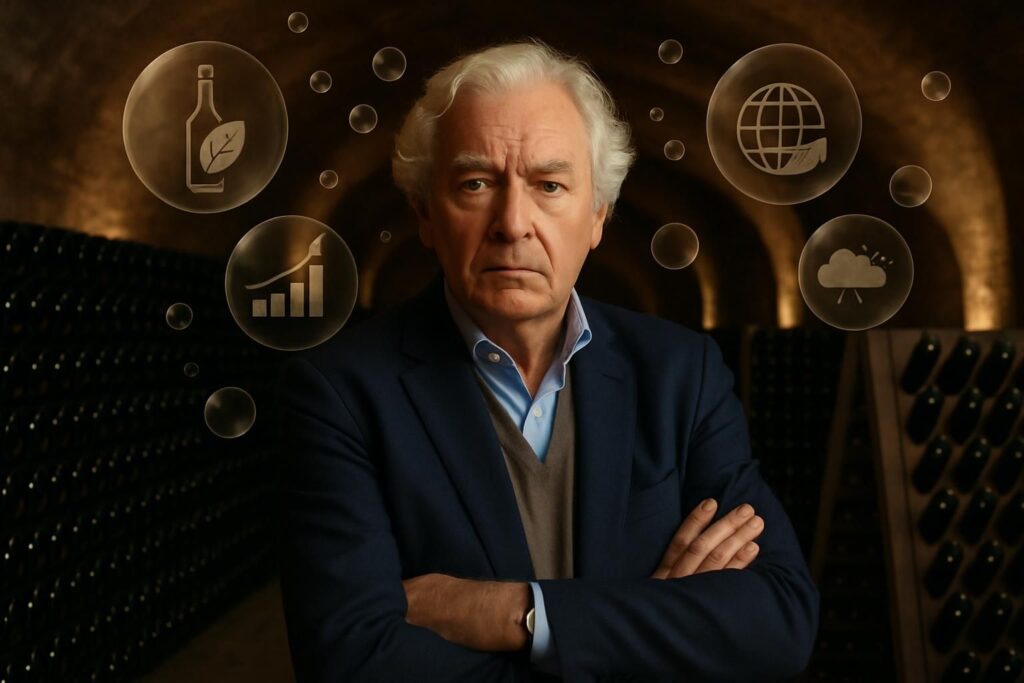
For half a century, Paul-François Vranken has established himself as a key player in Champagne. The Liégeois who managed to conquer this renowned terroir built his reputation by acquiring prestigious houses and developing a wine empire consolidated on the stock market. Yet, after these years of success, the Vranken-Pommery Monopole group is facing a fragile situation, with a debt now approaching 750 million euros against a slowing global market. This financial tension highlights the difficulties in maintaining a balance between tradition and innovation in a region subject to economic and ecological uncertainties. Attention today focuses on the current challenges faced by Paul-François Vranken, while sustainability and wine quality stand out as major issues in the Champagne wine industry.
The growth strategy through acquisitions, while it allowed the group to become the third-largest global Champagne operator, now seems confronted with the complexity of delicate business management. The intertwining of family heritage and contemporary financial demands further complicates the way forward. This situation also raises questions about the future of emblematic brands such as Pommery, whose survival is now uncertain due to bank debt pressure and market developments.
Beyond economic challenges, Paul-François Vranken must also adapt to environmental and regulatory changes that deeply disrupt the Champagne landscape. Climate change, the need for increased sustainability, and the constant pursuit of innovation now constitute new areas of expertise and vigilance for this passionate leader, whose career illustrates both the triumphs and turbulences of contemporary Champagne.
Bank debt and its repercussions on Vranken-Pommery Monopole’s governance
The financial health of Vranken-Pommery Monopole is today marked by significant debt, estimated at around 750 million euros by the end of 2025. This heavy indebtedness weighs on the group’s investment capacity and requires rigorous resource management, in a context where the Champagne market shows signs of slowdown. The need to renegotiate deadlines, such as the 50 million euros due in April 2026, underlines the tensions driving governance.
The recent transfer of power between Paul-François Vranken and his daughter Nathalie, who took over the presidency at the beginning of 2026, reflects a desire for renewal in leadership. However, this transition takes place in a delicate framework, where the financial strategy must reconcile the desire to sustain historic brands with managing a machine bogged down by banking constraints. This situation reflects a break: whereas growth was once boosted by ambitious investments and numerous acquisitions, the group must now revisit its economic model and favor a more stable foundation.
Financial tensions are also reflected in their commercial dynamics. Paul-François Vranken had implemented an aggressive pricing policy often characterized by systematic promotions, notably 1+1 operations. While this approach allowed for a certain sales volume, it is now being questioned as it hinders the ability to generate sustainable margins and undermines the valorization of products. The group is therefore facing a paradox: how to reconcile commercial attractiveness and financial profitability in a market that also demands impeccable wine quality?
In this context, governance had to strengthen to better respond to challenges. The Board of Directors, meeting at the end of 2024 under the chairmanship of Paul-François Vranken, initiated measures to optimize overall operations. This notably includes better anticipation of debt maturities, clarification of responsibilities within the group, and refocusing on the core Champagne business, facing geographical diversification around estates such as Château La Gordonne in Provence or Domaine Royal de Jarras in the Camargue.
Innovation and adaptation: addressing climate change challenges in the Champagne wine industry
Champagne is a unique region in the global wine industry, not only for its prestige but also for the fragility of its ecosystem. Climate change disrupts traditional growing conditions, requiring Champagne houses, including those led by Paul-François Vranken, to review their agricultural and oenological practices.
Faced with extreme climatic events, such as increasingly frequent heatwaves that weaken the vines, sustainability has become imperative. Measures to reduce environmental impact now incorporate innovative practices such as precision agriculture, limiting chemical treatments, and increased use of technologies to better understand soils and vine health. These efforts are part of a deep desire to align tradition and modernity in order to preserve wine quality over the long term.
The Pompadour house, launched by Paul-François Vranken in the early 2000s, exemplifies this sustainable innovation dynamic. By investing in this House, he promotes a strategy combining respect for the terroir with the constant pursuit of improved production methods. Thus, this engaging approach responds to growing consumer expectations for social and environmental responsibility while strengthening the group’s position in a global market where quality and authenticity remain major selection criteria.
These adaptations are not only ecological but also involve revisiting management tools, with increased digital integration and better anticipation of climate hazards. The mapping of Champagne cellars, for example, now accessible through innovative initiatives, allows better inventory control and qualitative refinement of vintages. Although these technologies require significant investments, they provide a vital competitive advantage.
In this area, the Vranken-Pommery Monopole group faces the challenge of maintaining its heritage while innovating. Sustainable transformation projects require funds that are often difficult to mobilize in the current company context. Yet, there is no doubt that this quest for innovation and adaptation remains indispensable to stay a major player in a constantly evolving wine world.
Global Champagne market: how Paul-François Vranken adjusts his positioning strategy
Commercial positioning in a rapidly evolving global Champagne market demands rethinking the overall strategy of the Vranken-Pommery Monopole group. Since the first expansions, the brand has relied on a portfolio including Pommery, Heidsieck & Co Monopole, Charles Lafitte, but also initiatives outside Champagne such as Pink Flamingo in the Camargue, thus confirming controlled geographic diversification.
However, competition on the international market is intensifying. Consumers seek authentic products but also those carrying strong values, especially regarding sustainability and innovation. The group observes this growing demand while having to contend with competitive pressure from other dynamic sparkling wines, such as Prosecco, which manages to capture attention through attractive pricing and a young, dynamic image.
Recent market studies indicate that Champagne producers must now combine historical know-how with a strong ability to adapt to global trends. Paul-François Vranken, gradually transferring management to the next generation, demonstrates a willingness to evolve strategic directions to meet new challenges, notably by modernizing communication and enhancing the craftsmanship of prestigious cuvées like “Louise Millésimé” or “Cuvée Louise Rosé.”
This commercial reconfiguration is accompanied by increased attention to emerging markets and the digitalization of distribution channels. The group thus relies on online platforms and diversified channels to strengthen its global presence. However, debt management remains a limiting factor requiring constant vigilance in order not to compromise this ambition.
This evolving strategy echoes the global challenges facing Champagne, notably the threat to the appellation and the need to protect and enhance the terroir. Collaborations with local actors, defense associations, and sector experts are multiplying to convey these messages and ensure a sustainable future.
Business management and human challenges: renewal and transmission within the Vranken group
Beyond financial and environmental variables, business management within the Vranken-Pommery Monopole group must incorporate essential human elements. The leadership transfer to Nathalie Vranken, recently completed, illustrates the complexity of handing over in a family group while maintaining competitive performance in the market.
This generational renewal takes place in a context where modern governance issues are strongly felt. The leadership team has had to implement a more agile and horizontal organization, capable of encouraging innovation while maintaining operational rigor to meet shareholder and financial market demands. This structuring work is crucial to ensuring the group’s sustainability while preserving founding values.
The focus on training managers, welcoming external talents, and developing an innovative corporate culture reflects this commitment. One of the major challenges remains balancing respect for traditions with openness to change, especially in an industry where wine quality cannot be sacrificed for purely commercial objectives.
Moreover, social impact is also at the heart of concerns. Champagne houses play an important role in the local economy, generating jobs and dynamism. Vranken-Pommery Monopole’s ability to support its teams and accompany the local fabric is thus a strategic issue, both for retention and societal responsibility.
The human challenges of this transition are therefore intimately linked to other issues: they largely determine Paul-François Vranken and his successors’ ability to successfully meet the many challenges facing Champagne.
Key lists to understand the current challenges of Paul-François Vranken in Champagne
- Massive indebtedness: impact on margins, need for financial restructuring.
- Climate change: adaptation of viticultural practices, enhanced sustainability.
- International competition: rise of Prosecco and other dynamic sparkling wines.
- Governance renewal: generational transition and modernization of managerial practices.
- Innovation and technology: digital integration and precision agriculture.
- Commercial pressure: balancing promotions and preserving wine quality.
- Protection of the Champagne appellation: key issue in the face of regulatory and environmental threats.
These elements reflect both the complexity of the path traveled by Paul-François Vranken and the horizons still to explore to maintain the flagship group’s rank in Champagne in a demanding market.
Understanding the pressures on the Champagne appellation and the dynamics of the sparkling wine market such as Prosecco offer valuable insight into the regulatory and competitive contexts faced by Paul-François Vranken.
What are the main causes of the significant debt at Vranken-Pommery Monopole?
The debt is mainly explained by accelerated growth financed by massive loans, combined with an aggressive commercial policy and a slowing market, complicating the generation of sufficient liquidity.
How does climate change impact champagne production?
It causes alterations in vine cycles, promotes heatwave episodes and requires adaptation of cultivation practices to preserve grape quality and health.
How do technological innovations help meet current challenges?
They allow better vine management through precise data, reduction of chemical inputs, and optimized planning of work in the cellar and vineyard.
What risks does the rise of Prosecco pose to Champagne houses?
Prosecco, with its dynamic image and competitive price, captures a significant share of the sparkling wine market, forcing Champagne houses to rethink their marketing and segmentation.
How does the new generation handle challenges within the Vranken group?
They promote more agile governance, balance heritage and innovation, and commit to modernizing methods while maintaining high quality standards.