
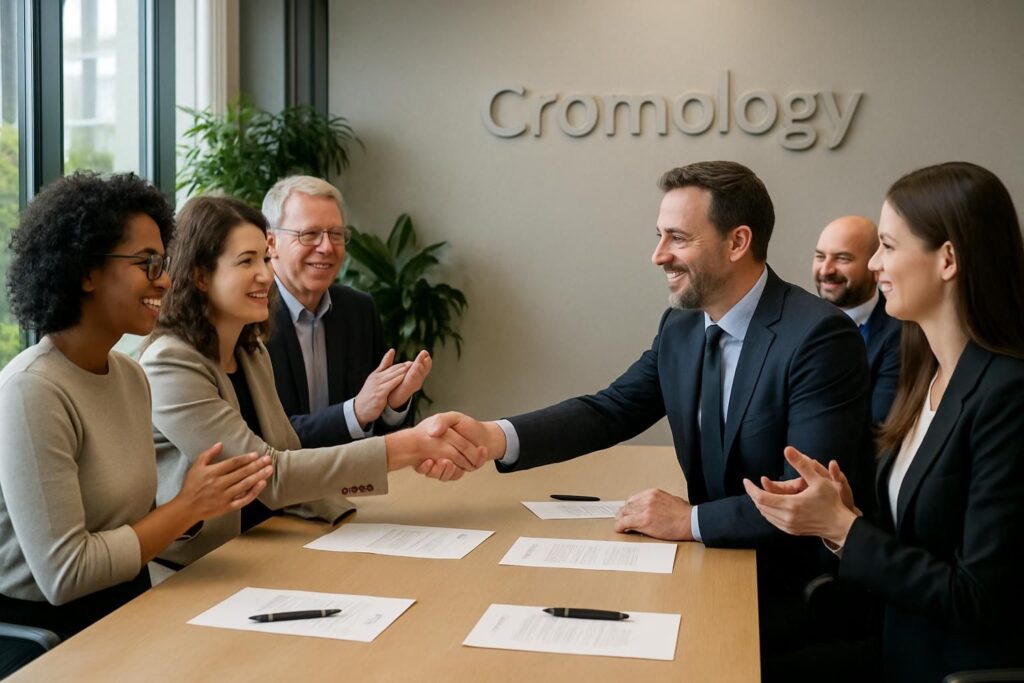
The recent agreement concluded between the management of Cromology and the permanent employees marks an important milestone in the management of social conflicts within the company. This resolution comes at the end of a period of tension, marked by a strike that established a more open and constructive social dialogue. The economic context, fragile for several years, particularly in the painting and decoration sector, has exacerbated the employees’ demands. Faced with this situation, the negotiation succeeded in finding a balanced common ground, bringing together the interests of employees and management. This rapprochement demonstrates the shared willingness to overcome obstacles and restore stability within the company.
The strike, initiated by the permanent employees, responded to specific expectations related to working conditions and salary recognition. It was a complex social conflict involving a large part of the teams. The management, aware of the stakes, engaged in a deep social dialogue to reach a satisfactory agreement. This accord is not only a punctual victory but also represents a model for conflict resolution in a professional environment where consultation is essential for the sustainability of activities.
Beyond the simple end of the strike movement, the agreement signed with Cromology embodies a dynamic that prioritizes communication and consultation. This facilitates the restarting of industrial and commercial projects by avoiding the negative impact of blockages. Furthermore, this situation illustrates the growing complexity of corporate social relations in 2026, where economic pressure and employees’ demands balance out in a sometimes arduous but constructive dialogue. The success of these negotiations therefore relies on thoughtful compromises, adapted to Cromology’s specific context, a major player in the sector.
The strategic stakes of the permanent employees’ strike at Cromology
The strike initiated by the permanent employees at Cromology highlighted several strategic dimensions, revealing the challenges facing the company. In a sector where competition and market fluctuations are unceasing, salary demands and working conditions pose significant challenges to sustainability.
Firstly, the economic impact of this social conflict cannot be underestimated. The strike, which lasted several weeks, disrupted the production chain and delayed product delivery. This generated not only a loss of turnover but also a temporary deterioration of commercial relations with certain key clients, sensitive to service continuity and deadline reliability.
Secondly, the permanent employees are the pillars of technical expertise and production quality. Their mobilization reflects a deep discomfort, not only regarding remuneration but also concerning the recognition of their role in the value chain. Thus, the conflict highlighted the need for a more proactive human resources management and an appropriate social policy to preserve motivation and talent retention. The negotiations allowed these considerations to be integrated into the agreement, notably by providing specific measures regarding training and working conditions.
Finally, this episode had an amplifying effect on social dialogue throughout the company. Management chose to respond with attentive listening and transparency, taking into account not only financial demands but also aspirations for a better work-life balance. This approach aligns with a general trend within companies where the human dimension becomes an essential strategic priority. These challenges confirm that managing permanent employees, especially during periods of tension, is crucial to ensure Cromology’s stability and competitiveness.
Course of the negotiation and conclusion of the agreement with Cromology
The negotiation phase between Cromology management and the permanent employees was characterized by a strong will from both parties to find a lasting compromise. From the outset, management set the framework for an open social dialogue, aware of the risks that prolonging the conflict posed to the company’s overall activities.
The discussions were built around several essential axes: improving salary conditions, recognizing the specific skills of permanent employees, as well as adapting schedules to better reconcile professional and personal life. These topics were debated rigorously, each party arguing their respective stakes, in a tense but respectful atmosphere.
A key element lies in the inclusion in the agreement of measures aimed at sustaining social dialogue, notably through the creation of monitoring committees and mediation bodies. This ensures that future disputes can be handled constructively before degenerating into open conflicts.
This proactive approach gradually restored a climate of trust between management and employees. The final agreement, validated by staff representatives, marks a true turning point in the management of social relations within Cromology. Several innovative clauses enhance the role of permanent employees by introducing, for example, continuous training programs and bonuses linked to collective performance.
These advances demonstrate a win-win agreement, where the interests of the company and those of the permanent employees converge towards a common objective: the sustainable and profitable development of Cromology. The success of this negotiation thus illustrates the importance of structured social dialogue to overcome the difficulties encountered during conflicts.
Economic and social consequences of the post-strike agreement at Cromology
The agreement concluded with Cromology management after the permanent employees’ strike has significant impacts both economically and socially. On the economic front, the end of the social conflict allowed for the resumption of production and the restoration of the supply chain, vital for a company whose activity depends on the rapid and efficient delivery of products.
The return to operational stability takes place in a context of cautious recovery in the painting and decoration market. After several years of slowdown, the sector is experiencing a stabilization phase, although indicators remain fragile. Anticipation of a more favorable second half rests on a better-controlled economic environment made possible by strong social agreements.
The social agreement also contains measures aimed at improving well-being at work, which indirectly favors productivity. The introduction of flexible schedules, coupled with an enhanced training plan, helps maintain permanent employees’ engagement and reduce turnover. Furthermore, the inclusion of a collective performance bonus encourages strengthened team spirit and shared responsibilities.
On the social level, this peaceful resolution of the conflict demonstrates that dialogue and negotiation are effective levers for preventing and managing tensions. It also plays a positive role in Cromology’s image, highlighting its ability to navigate a complex context while preserving employment and consolidating its human capital.
Cromology’s initiative aligns with practices recommended internationally, notably regarding professional equality and improving working conditions, as highlighted by some recent company agreements. The company’s example thus sheds light on the need for companies to develop innovative social strategies to meet employees’ expectations while controlling their costs.
Long-term perspectives for Cromology after resolving the social conflict
Beyond the immediate settlement, the agreement reached between management and permanent employees at Cromology lays the foundation for a lasting dynamic centered on social dialogue. Lessons learned from this strike period encourage strengthening participatory mechanisms to avoid future conflicts. The creation and maintenance of communication channels are of strategic importance to anticipate employees’ needs and market developments.
Moreover, the measures planned to support continuous training reflect a forward-looking vision. In a sector subject to increasing technological and environmental changes, the upskilling of permanent employees appears as an essential lever for competitiveness and innovation.
Cromology’s management thus presents a proactive policy aimed not only at stabilizing social relations but also at driving qualitative renewal of human resources. This strategy fits into a logic of permanent adaptation to the global economic context. The agreement plays a symbolic role by showing that a social conflict can turn into an opportunity to create shared added value.
Finally, Cromology’s example also illustrates the need for integrated social risk management, particularly in a company where team cohesion is decisive. The ability to reconcile permanent employees’ expectations with economic performance objectives is a major challenge. This experience opens the way to a new era of social dialogue, where negotiation becomes a central tool in the service of growth and social responsibility.
- Attentive listening and transparency as keys to effective social dialogue.
- Concrete measures to improve working conditions and remuneration.
- Continuous training to support professional development.
- Collective bonuses to strengthen team spirit and performance.
- Monitoring committees ensuring sustainable dialogue between employees and management.
To deepen the issues related to international agreements impacting energy and industrial sectors, it is relevant to consult recent analyses on champagne.news/accord-ue-australie-electricite/”>the EU-Australia agreement in the field of electricity. Similarly, the development of multisport activities in related sectors offers interesting prospects, as described in multisport initiatives at Champagne Mouton, showing how companies adapt to new economic and social dynamics.
What were the main demands of permanent employees during the strike?
The permanent employees mainly demanded a salary increase, better recognition of their skills, and improved working conditions, notably in terms of schedule arrangements.
How did Cromology’s management handle the social conflict?
Management adopted an approach based on social dialogue, transparency, and negotiation, by setting up monitoring committees to ensure regular handling of employees’ concerns.
What benefits does the agreement bring to the company?
The agreement allows Cromology to stabilize production, improve the satisfaction and motivation of permanent employees, while strengthening the company’s competitiveness and economic sustainability.
What measures are in place to prevent future social conflicts?
The creation of monitoring committees and mediation bodies facilitates ongoing dialogue between management and employees, enabling anticipation and swift resolution of disputes.
Why is continuous training essential in this agreement?
Continuous training is a key lever to maintain and develop skills in the face of technological and environmental changes, thus ensuring the adaptability and performance of permanent employees.