
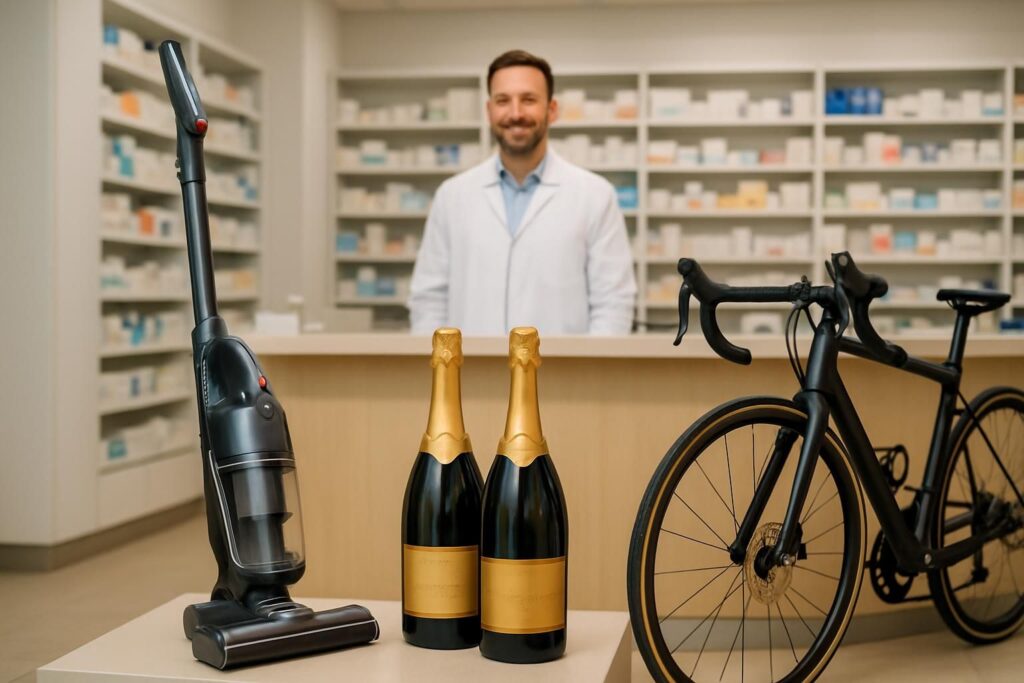
At the heart of Orne, a sensational case shakes the pharmaceutical world: the Urgo laboratory has been singled out for having offered more than €22,000 in gifts to a single pharmacy. High-end vacuum cleaners, exceptional bottles of champagne, and even an electric bike were among these presents. These benefits, far from being trivial, raise questions about commercial practices and the sometimes blurred line between pharmaceutical marketing and commercial considerations. This situation reflects a broader phenomenon involving thousands of healthcare professionals throughout France, exposed to questionable practices in a strict legislative context governing relations between laboratories and pharmacies.
This case highlights the complex mechanisms of promotional offers and customer rewards in a sector known for its ethical demands. Pharmacists, supposed to guarantee the integrity of their profession, often find themselves destabilized by tempting proposals, thus diverting the very role of the pharmacy. A thorough analysis of these often tacit practices invites reflection on the current regulatory framework, the influence of pharmaceutical laboratories, and the consequences of such a system for consumer trust.
The background of the gifts offered by the Urgo laboratory: a significant impact on the pharmaceutical sector
The Urgo laboratory, specialized in consumer health and medical devices, has been at the center of controversies related to its pharmaceutical marketing methods for several years. Offering gifts to pharmacies is not new, but the scale of the amounts and the nature of the items given raise questions about compliance with the ethical rules established to regulate these practices.
In the case of the recently condemned pharmacy in Domfront-en-Poiraie, it is not just about small symbolic presents. Professional vacuum cleaners, rare champagne sets from major houses, and even electric bikes were granted, totaling more than €22,000 in value. A substantial discount that far exceeds what the law permits, particularly the famous “anti-gift law” adopted to prevent any risk of corruption or conflict of interest in the pharmaceutical distribution chain.
Pharmaceutical marketing, under the guise of a “promotional offer,” sometimes pushes ethical boundaries. For a pharmacist, accepting these rewards may seem advantageous in the short term but induces dependency on suppliers and influences supply choices. The line between commercial incentive and disguised pressure thus becomes very thin, threatening professional independence.
- The scale of gifts generally exceeds goods strictly related to professional activity, such as IT or pharmacy equipment.
- The expected counter-performances often go further: exclusive promotion of certain products in the pharmacy or price reductions in return.
- The anti-gift law, in effect for several years, struggles to be respected or effectively controlled.
The case of this pharmacy remains emblematic of a system where certain laboratories play on multiple fronts, putting a key link of the healthcare system under strain. This issue is far from marginal since more than 8,500 French pharmacies are suspected of similar practices, with a cumulative total of gifts amounting to several tens of millions of euros. A true collective reassessment is necessary for the sector.
Champagne in pharmaceutical marketing: a strategy with festive appearances but contested
Champagne, a symbol of excellence and celebration, has become a key element in certain promotional strategies by pharmaceutical laboratories, as evidenced by this case. Offering prestigious bottles to pharmacists goes beyond a simple commercial gesture and is part of a more subtle approach of influence and recognition.
In the champagne world, renowned houses such as Maison Grande Champagne in Segonzac embody an accessible luxury and a valued cultural symbol, sometimes diverted as a business gift tool. The emotional and symbolic value of champagne bottles encourages a favorable reception of gifts, strengthening ties between suppliers and pharmacy professionals. Exclusive events or collector’s sets can thus become levers of a form of professional loyalty.
However, this practice, although attractive, raises questions about ethics and the balance of commercial relations. Champagne should never become a currency that distorts the transparency of pharmaceutical decisions. The relationship between these gifts and respect for ethical obligations remains delicate, especially in view of the strict French legislation on anti-corruption and transparency.
This phenomenon of champagne as a “customer reward” also resonates in other sectors, but it takes on a particular dimension in pharmacy, given the health role of these establishments. The line between a gift intended to mark a partnership and a genuine disguised incentive is more than blurred.
To better understand the impact of these practices, it is interesting to examine several aspects:
- The choice of high-end champagne, a symbol of accessible and appreciated luxury in professional circles;
- The frequency and value of gifts that sometimes exceed regulatory ceilings;
- The authorities’ reactions and judicial consequences for the protagonists involved.
Specialized articles such as those published on Maison Grande Champagne Segonzac provide a precise overview of the place of quality champagne in current commercial and cultural dynamics, underlining the importance of rigorous ethical management of such benefits.
Vacuum cleaners and bikes: surprising gifts but revealing of an aggressive commercial strategy
Far from the classic contours of professional gifts, the offer of vacuum cleaners and bikes represents a concrete and unusual approach in the sector of benefits granted to pharmacies. These items, of significant commercial value, show a clear will to attract pharmacy professionals in a highly competitive context.
Professional vacuum cleaners, often used in pharmacy premises, symbolize a gift directly attributable to daily activity. Yet, their free distribution often conceals a well-established influence strategy: in exchange, the pharmacy commits to favoring certain products from the laboratory, which distorts the free choice of medicines and devices offered to the public.
As for the electric bike, it illustrates both the aspect of a “high-tech gift” and the external visibility provided by such a highly perceived value item. This type of gift also fits within a promotional dynamic where the laboratory capitalizes on the notoriety and loyalty of pharmacies struggling in a very competitive market.
This pharmaceutical marketing strategy, based on sometimes ostentatious rewards, calls attention to the need to strengthen control and transparency within distribution. It also shows that laboratories do not skimp on means to maintain or secure a privileged place on pharmacy shelves.
- Objects related to professional activity diverted to mask a promotional offer;
- Gifts with a high perceived value to establish loyalty and commercial recognition;
- Possible impacts on the pharmacist’s free choice and, ultimately, on the patient.
While this situation is the subject of judicial convictions, it unfortunately remains revealing of a risky commercial model that urgently needs to be revisited to preserve pharmaceutical integrity.
Legal and ethical consequences of Urgo gifts in the pharmaceutical sector
Gift practices, particularly when they exceed reasonable limits and compromise the freedom of prescription or product promotion, have led to heavy judicial sanctions for several pharmacists and the Urgo laboratory itself. The Argentan court, notably, recently condemned a pharmacist for having accepted gifts contrary to the deontology expected of her profession.
This conviction is part of a broader dynamic where the justice system recalls that the anti-gift law is a fundamental pillar to prevent corruption and ensure the balance of the pharmaceutical market. It also aims to protect the patient, the last link in the chain, by ensuring that pharmaceutical choices are based on health criteria and not commercial ones.
Penalties usually range from €2,000 to €7,000 in fines, but the media and professional impact is often much greater. Furthermore, the case brought attention to more than 8,500 pharmacies suspected of having benefited from undue advantages, representing a total of €54 million in gifts and various items.
In this context, transparency and the establishment of strict controls appear as essential levers to restore trust between patients, pharmacists, and laboratories. The legal and ethical task is immense, and vigilance must be constant to avoid repeating past mistakes.
- Increasing judicial sanctions against offending pharmacists and laboratories;
- Strengthening regulations on commercial relations in the health sector;
- Greater commitment to transparency in promotional offers and discounts;
- Protection of patients against possible mercantile drift.
The stakes obviously go beyond the pharmacy concerned. They underline the need for a lasting reform of governance in the relationship between laboratories and pharmacies, in order to ensure a practice that is integral and compliant with societal expectations.
Perspectives and measures to effectively regulate promotional offers in pharmacies
In the face of the abuses noted in the Urgo case, several avenues for reflection and improvement proposals are emerging to better regulate promotional offers and preserve ethics in the pharmaceutical sector. It is about finding a fair balance between legitimate commercial incentives and strict compliance with ethical rules.
One of the first measures consists of increased control, notably by the Order of Pharmacists and the competent authorities, of gifts and benefits offered by pharmaceutical laboratories. Total transparency on the value of the gifts and their nature would help limit abuses and establish a culture of responsibility.
Moreover, the training of pharmacists and pharmacy teams on the legal and ethical limits of promotional offers is a fundamental element. In 2026, a real information effort must accompany any legislative change to prevent similar situations from continuing.
Finally, strengthened collaboration between laboratories, healthcare professionals, and authorities must develop to create codes of conduct and firm commitments ensuring that commercial practices respect the sector’s values. This approach could be inspired by other fields where ethical rigor is a priority, such as the wine industry where quality is paramount and achieved without resorting to opaque methods.
To illustrate this path, one can refer to initiatives in the champagne domain, where prestigious houses cultivate their image through transparency and finesse, as seen in the information available on the French champagne market or on the responsible management of a customer reward in a circuit respectful of the rules.
- Strengthening regulatory controls on promotional offers;
- Training and awareness of pharmacists on ethical rules;
- Creation of shared ethics charters between laboratories and pharmacies;
- Total transparency on the nature and value of gifts;
- Encouragement of responsible and fair commercial practices.
If these measures are effectively implemented, they will help restore a relationship of trust, essential to guaranteeing quality service for the patient and the sustainability of the pharmaceutical sector.
What types of gifts are forbidden to pharmacists by law?
The anti-gift law forbids any significant material advantage, especially those that could influence prescription or product choice. Gifts must be directly related to professional activity and have a moderate value.
Why do gifts offered by laboratories like Urgo pose a problem?
They can bias pharmacists’ neutrality, create conflicts of interest, and compromise the quality of advice given to patients. Moreover, these gifts are often disproportionate with respect to the legal framework.
What sanctions are provided in case of non-compliance with the anti-gift law?
Sanctions include fines ranging from €2,000 to €7,000, disciplinary penalties, and in some cases, heavier judicial proceedings.
How to ensure transparency in relations between laboratories and pharmacies?
The implementation of mandatory declarations, control by competent authorities, and the development of ethical charters between parties are essential to ensure transparency.
Are there ethical alternatives to traditional gifts in pharmaceutical marketing?
Yes, alternatives such as professional training funded by laboratories, scientific information materials, and educational events are favored to strengthen competence without compromising integrity.
Pharmaceutical marketing, under the guise of a “promotional offer,” sometimes pushes ethical boundaries. For a pharmacist, accepting these rewards may seem advantageous in the short term but induces dependency on suppliers and influences supply choices. The line between commercial incentive and disguised pressure thus becomes very thin, threatening professional independence.
- The scale of gifts generally exceeds goods strictly related to professional activity, such as IT or pharmacy equipment.
- The expected counter-performances often go further: exclusive promotion of certain products in the pharmacy or price reductions in return.
- The anti-gift law, in effect for several years, struggles to be respected or effectively controlled.
The case of this pharmacy remains emblematic of a system where certain laboratories play on multiple fronts, putting a key link of the healthcare system under strain. This issue is far from marginal since more than 8,500 French pharmacies are suspected of similar practices, with a cumulative total of gifts amounting to several tens of millions of euros. A true collective reassessment is necessary for the sector.
Champagne in pharmaceutical marketing: a strategy with festive appearances but contested
Champagne, a symbol of excellence and celebration, has become a key element in certain promotional strategies by pharmaceutical laboratories, as evidenced by this case. Offering prestigious bottles to pharmacists goes beyond a simple commercial gesture and is part of a more subtle approach of influence and recognition.
In the champagne world, renowned houses such as Maison Grande Champagne in Segonzac embody an accessible luxury and a valued cultural symbol, sometimes diverted as a business gift tool. The emotional and symbolic value of champagne bottles encourages a favorable reception of gifts, strengthening ties between suppliers and pharmacy professionals. Exclusive events or collector’s sets can thus become levers of a form of professional loyalty.
However, this practice, although attractive, raises questions about ethics and the balance of commercial relations. Champagne should never become a currency that distorts the transparency of pharmaceutical decisions. The relationship between these gifts and respect for ethical obligations remains delicate, especially in view of the strict French legislation on anti-corruption and transparency.
This phenomenon of champagne as a “customer reward” also resonates in other sectors, but it takes on a particular dimension in pharmacy, given the health role of these establishments. The line between a gift intended to mark a partnership and a genuine disguised incentive is more than blurred.
To better understand the impact of these practices, it is interesting to examine several aspects:
- The choice of high-end champagne, a symbol of accessible and appreciated luxury in professional circles;
- The frequency and value of gifts that sometimes exceed regulatory ceilings;
- The authorities’ reactions and judicial consequences for the protagonists involved.
Specialized articles such as those published on Maison Grande Champagne Segonzac provide a precise overview of the place of quality champagne in current commercial and cultural dynamics, underlining the importance of rigorous ethical management of such benefits.
Vacuum cleaners and bikes: surprising gifts but revealing of an aggressive commercial strategy
Far from the classic contours of professional gifts, the offer of vacuum cleaners and bikes represents a concrete and unusual approach in the sector of benefits granted to pharmacies. These items, of significant commercial value, show a clear will to attract pharmacy professionals in a highly competitive context.
Professional vacuum cleaners, often used in pharmacy premises, symbolize a gift directly attributable to daily activity. Yet, their free distribution often conceals a well-established influence strategy: in exchange, the pharmacy commits to favoring certain products from the laboratory, which distorts the free choice of medicines and devices offered to the public.
As for the electric bike, it illustrates both the aspect of a “high-tech gift” and the external visibility provided by such a highly perceived value item. This type of gift also fits within a promotional dynamic where the laboratory capitalizes on the notoriety and loyalty of pharmacies struggling in a very competitive market.
This pharmaceutical marketing strategy, based on sometimes ostentatious rewards, calls attention to the need to strengthen control and transparency within distribution. It also shows that laboratories do not skimp on means to maintain or secure a privileged place on pharmacy shelves.
- Objects related to professional activity diverted to mask a promotional offer;
- Gifts with a high perceived value to establish loyalty and commercial recognition;
- Possible impacts on the pharmacist’s free choice and, ultimately, on the patient.
While this situation is the subject of judicial convictions, it unfortunately remains revealing of a risky commercial model that urgently needs to be revisited to preserve pharmaceutical integrity.
Legal and ethical consequences of Urgo gifts in the pharmaceutical sector
Gift practices, particularly when they exceed reasonable limits and compromise the freedom of prescription or product promotion, have led to heavy judicial sanctions for several pharmacists and the Urgo laboratory itself. The Argentan court, notably, recently condemned a pharmacist for having accepted gifts contrary to the deontology expected of her profession.
This conviction is part of a broader dynamic where the justice system recalls that the anti-gift law is a fundamental pillar to prevent corruption and ensure the balance of the pharmaceutical market. It also aims to protect the patient, the last link in the chain, by ensuring that pharmaceutical choices are based on health criteria and not commercial ones.
Penalties usually range from €2,000 to €7,000 in fines, but the media and professional impact is often much greater. Furthermore, the case brought attention to more than 8,500 pharmacies suspected of having benefited from undue advantages, representing a total of €54 million in gifts and various items.
In this context, transparency and the establishment of strict controls appear as essential levers to restore trust between patients, pharmacists, and laboratories. The legal and ethical task is immense, and vigilance must be constant to avoid repeating past mistakes.
- Increasing judicial sanctions against offending pharmacists and laboratories;
- Strengthening regulations on commercial relations in the health sector;
- Greater commitment to transparency in promotional offers and discounts;
- Protection of patients against possible mercantile drift.
The stakes obviously go beyond the pharmacy concerned. They underline the need for a lasting reform of governance in the relationship between laboratories and pharmacies, in order to ensure a practice that is integral and compliant with societal expectations.
Perspectives and measures to effectively regulate promotional offers in pharmacies
In the face of the abuses noted in the Urgo case, several avenues for reflection and improvement proposals are emerging to better regulate promotional offers and preserve ethics in the pharmaceutical sector. It is about finding a fair balance between legitimate commercial incentives and strict compliance with ethical rules.
One of the first measures consists of increased control, notably by the Order of Pharmacists and the competent authorities, of gifts and benefits offered by pharmaceutical laboratories. Total transparency on the value of the gifts and their nature would help limit abuses and establish a culture of responsibility.
Moreover, the training of pharmacists and pharmacy teams on the legal and ethical limits of promotional offers is a fundamental element. In 2026, a real information effort must accompany any legislative change to prevent similar situations from continuing.
Finally, strengthened collaboration between laboratories, healthcare professionals, and authorities must develop to create codes of conduct and firm commitments ensuring that commercial practices respect the sector’s values. This approach could be inspired by other fields where ethical rigor is a priority, such as the wine industry where quality is paramount and achieved without resorting to opaque methods.
To illustrate this path, one can refer to initiatives in the champagne domain, where prestigious houses cultivate their image through transparency and finesse, as seen in the information available on the French champagne market or on the responsible management of a customer reward in a circuit respectful of the rules.
- Strengthening regulatory controls on promotional offers;
- Training and awareness of pharmacists on ethical rules;
- Creation of shared ethics charters between laboratories and pharmacies;
- Total transparency on the nature and value of gifts;
- Encouragement of responsible and fair commercial practices.
If these measures are effectively implemented, they will help restore a relationship of trust, essential to guaranteeing quality service for the patient and the sustainability of the pharmaceutical sector.
What types of gifts are forbidden to pharmacists by law?
The anti-gift law forbids any significant material advantage, especially those that could influence prescription or product choice. Gifts must be directly related to professional activity and have a moderate value.
Why do gifts offered by laboratories like Urgo pose a problem?
They can bias pharmacists’ neutrality, create conflicts of interest, and compromise the quality of advice given to patients. Moreover, these gifts are often disproportionate with respect to the legal framework.
What sanctions are provided in case of non-compliance with the anti-gift law?
Sanctions include fines ranging from €2,000 to €7,000, disciplinary penalties, and in some cases, heavier judicial proceedings.
How to ensure transparency in relations between laboratories and pharmacies?
The implementation of mandatory declarations, control by competent authorities, and the development of ethical charters between parties are essential to ensure transparency.
Are there ethical alternatives to traditional gifts in pharmaceutical marketing?
Yes, alternatives such as professional training funded by laboratories, scientific information materials, and educational events are favored to strengthen competence without compromising integrity.