
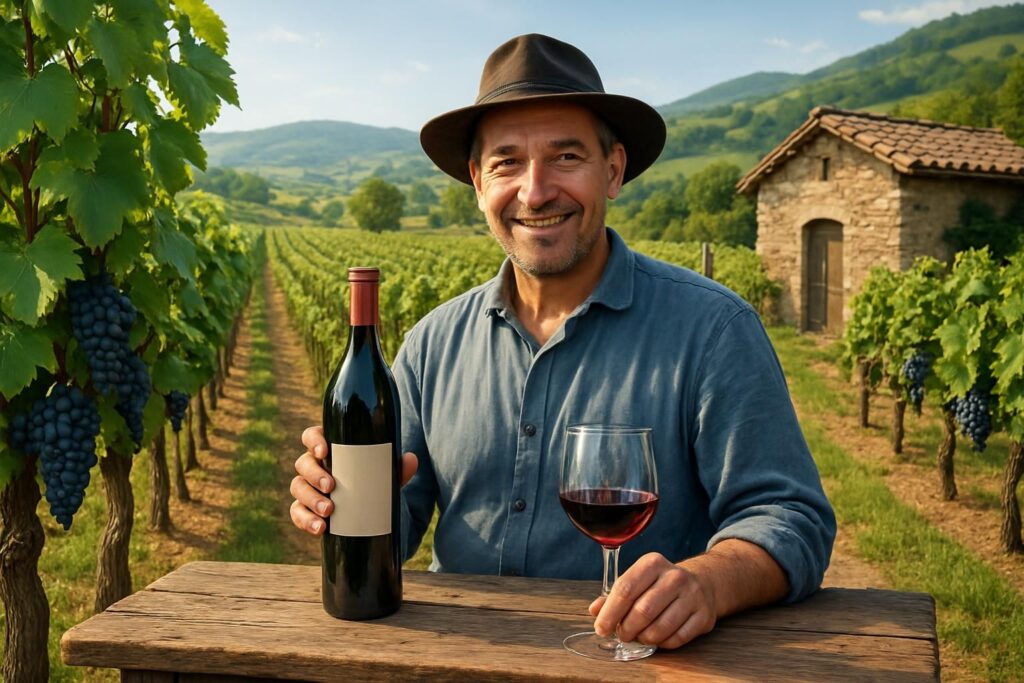
In the heart of deep Beaujolais, the commune of Lantignié is distinguished today by a new dynamic driven by its local wines. This village with a rich winemaking tradition, recognized for its unique terroirs and vinification respectful of traditional oenological practices, harbors a strong ambition: to make its vintages shine on the Champagne Stage, a major reference on the French and international wine market. To achieve this, the local wine production has managed to combine terroir knowledge, sustainable innovation, and smart promotion of its wines, in a context where authenticity and quality dictate consumer expectations.
Since its recent creation in June 2025, the Vins de Lantignié association brings together the energy of two-thirds of the village’s wine domains. It plays a driving role in the enhancement of the vintages, committing to promote not only the aromatic richness of the wines but also the history and identity of the terroir from which they draw their uniqueness. This ambition is part of a clear strategy to conquer new markets, notably in France and abroad, relying on the fundamentals of mastered artisanal vinification and a recognized eco-responsible approach.
The terroir of Lantignié: a viticultural richness serving wine quality
The terroir of Lantignié is the key element that gives its local wines a unique character. Located at the edges of Beaujolais, this terroir benefits from remarkable geology with a dominance of soils made up of 30% blue stone, a siliceous volcanic rock, and 60% pink granite. This soil diversity deeply influences the organoleptic qualities of the grapes, promoting the complexity and finesse of the grape varieties grown here.
Gamay, the emblematic grape variety of the region, finds in these conditions an ideal environment to express all its freshness, fruity notes, and a beautiful tension that appeals to both amateurs and wine professionals. In this area, the vine flourishes thanks to a temperate climate, offering a perfect balance between sunshine and rainfall, essential conditions for optimal ripening. Precise soil management by the winemakers, with special attention paid to biodiversity, results in qualitative wine production, respectful of the natural balance.
Beyond soil composition, it is the mastery of vinification that distinguishes Lantignié’s wines. The winemakers favor adapted and precise practices: controlled macerations, favored indigenous yeasts to preserve the pure expression of the fruit, and aging in noble but measured materials. These measured interventions play a fundamental role in the typicity of the wines, allowing the production of balanced and aromatic vintages, capable of seducing an increasingly demanding clientele.
These specificities are part of a sustainable viticulture approach. The local association, “Vignerons & Terroirs de Lantignié,” created more than ten years ago, works tirelessly to impose ecological standards that preserve this exceptional terroir. Biodynamic cultural practices, limited use of phytosanitary products, as well as the constant research to balance yields ensure not only the quality of the wine but also the sustainability of soils and landscapes, essential elements for long-term recognition, notably on demanding stages such as the Champagne one.
A declared ambition: integrating and shining on the Champagne Stage
On the French wine scene, the Champagne Stage represents a major strategic challenge. This platform for exchanges, exhibitions, and tastings brings together the great Champagne houses, innovative winemakers, as well as international actors in the sector. For a still little-known appellation like Lantignié, joining this stage signifies not only access to an influential network but also recognition of the quality and typicity of its local wines at a high level.
Since the formation of their association, the members of Vins de Lantignié have been actively preparing for this challenge. One of their main axes is highlighting the typical values of their terroir that the Champagne Stage cannot ignore, thanks to a clear marketing and promotion strategy. Regular meetings with specialized media, importers, and wholesalers, especially during fairs or events in Reims, as well as a strong presence in events dedicated to organic and sustainable wines, illustrate this willingness to engage in a dynamic of commercial and qualitative legitimacy.
To assert this ambition, the winemakers also rely on inspiring examples from the region. They particularly observe how Champagne producers integrate labels and distinctive origin signs that enhance their terroirs. The idea of a “sustainable appellation wine” offered alongside the classic AOC is a flagship project that could soon be launched in Lantignié. This initiative would aim to combine strong geographic recognition with an environmental guarantee, a response expected by distribution channels increasingly attentive to sustainable practices.
Observing and understanding current trends in the wine market and how actors such as those involved in the organic Champagne sector in Épernay succeed in attracting a demanding and diverse audience is a valuable source of inspiration for Lantignié. The village positions its wines not only as authentic terroir products but also with a more open stance towards export.
Vinification challenges in Lantignié to meet the expectations of a competitive market
Vinification in Lantignié receives particular attention, notably because it is one of the essential levers to produce local wines capable of competing with the most renowned producers on the Champagne Stage. The perceived quality depends largely on the winemakers’ expertise combined with rigorous respect for traditional and innovative techniques.
The complexity of the terroir requires continuous adaptation of oenological practices. Each vintage brings its share of challenges linked to climatic hazards, especially in this context where viticulture must face growing variability in weather conditions. The optimization of macerations, the rigorous selection of natural yeasts, and the choices in aging all contribute to refining the wines’ profile to maximize their fruity character, balance, and freshness.
Winemakers have incorporated modern oenological monitoring tools, without ever losing sight of the importance of precise and measured human interventions. This hybrid approach is a key element that allows them to offer a distinctive product, marked by aromatic purity and respect for the raw material. It illustrates both their commitment to terroir roots and a necessary technical evolution for contemporary standards.
This attention to detail is reinforced by eco-responsible practices. Vinification in Lantignié also aims to minimize chemical inputs and favor indigenous yeasts, which guarantees the most faithful expression of aromas and the uniqueness specific to the soils and climate of the region. Sustainability is thus integrated at the very heart of the process, creating a precious symbiosis between tradition and innovation.
Moreover, exchanges of experience among winemakers within the association foster the dissemination of good practices, tool sharing, and the organization of oenological workshops. These collective initiatives raise overall quality while strengthening cohesion within the local wine-making fabric.
Promotion of Lantignié wines: strategies and perspectives for national and international markets
Faced with a saturated market where competition is fierce, the promotion of local Lantignié wines is designed strategically and on multiple fronts. The Vins de Lantignié association implements an action plan aiming to increase the notoriety of the vintages through targeted operations on several fronts.
Participation in professional fairs, notably in Champagne, where event organization is an essential visibility vector, is a priority. Appointments such as the Grande Champagne Fair Expo or various events of the Spring Champagne Season in Épernay are ideal platforms to present the quality of Lantignié wines to an informed audience, made up of importers, distributors, and specialized media.
At the same time, creating a strong and modern visual identity fits into this promotional approach. It aims to attract a broader audience, especially young consumers looking for authentic wines carrying meaning, connected to environmental values. Communication also relies on innovative digital campaigns and tastings organized in major metropolitan areas, notably Lyon and Reims, two major hubs of the wine trade.
It is also about building privileged collaboration with actors of short circuits and restaurateurs engaged in promoting wines from specific terroirs. This strategy combines qualitative enhancement of the vintages with a coherent and efficient distribution network, serving both the local scene and export opportunities.
Finally, the emphasis placed on the region’s history and heritage, with its anecdotes, readings, and traditions, enriches the storytelling around Lantignié wines. This storytelling, especially appreciated during tastings and events, facilitates consumer appropriation of the wine. It creates a strong bond between product, territory, and the winemaker’s passion, thus strengthening the sense of belonging and loyalty.
Local winemakers know that the key lies in product quality, mastery of the enhancement chain, and effective communication. This dynamic now allows them to dare previously unseen ambitions, with a view to broader recognition, notably from professionals and enthusiasts of the prestigious Champagne stage.
Vins de Lantignié: a list of strengths that make them unique
- Unique terroir: granitic soils and blue stone, offering complexity and finesse.
- Artisanal vinification: adapted macerations, favored indigenous yeasts, measured aging.
- Ecological commitment: organic and biodynamic practices, respecting soils and biodiversity.
- Dynamic association: Vignerons & Terroirs de Lantignié supporting local and international promotion.
- Innovative promotion strategy: participation in Champagne fairs and targeted digital campaigns.
- Consistent quality: rigorous control of production stages guaranteeing balanced and aromatic vintages.
- Opening towards export: growing presence in foreign distribution networks.
Which grape varieties dominate wine production in Lantignié?
Production relies mainly on Gamay, a typical grape variety of Beaujolais, recognized for its fruity aromas and freshness.
How do the winemakers of Lantignié integrate sustainable practices?
They use environmentally respectful methods such as organic and biodynamic viticulture, limiting chemical inputs and preserving soil biodiversity.
What initiatives promote local wines?
The association organizes participation in professional fairs, tastings, and develops digital communication adapted to current market trends.
Why is the Champagne Stage strategic for Lantignié?
It offers significant visibility among wine professionals, allowing the positioning of Lantignié wines in a prestigious and competitive context.
What are the vinification challenges in this terroir?
Adaptation to climatic hazards and mastery of oenological processes are essential to guarantee coherent, typified, and high-quality wines.