
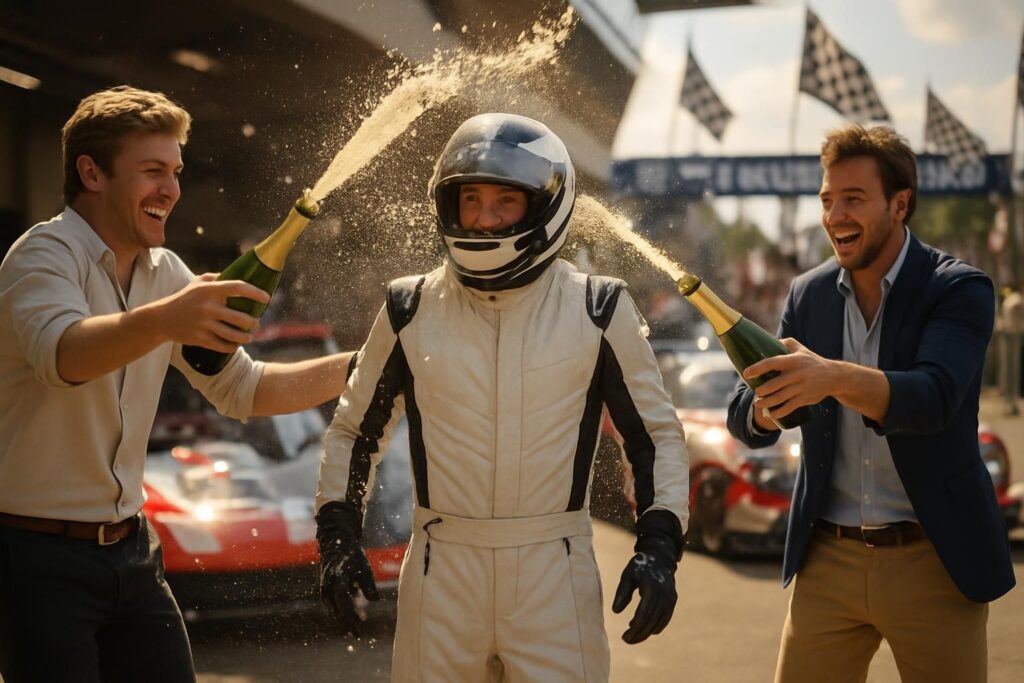
Every year, at the end of the 24 Hours of Le Mans, the stage on the podium becomes the setting for a very special celebration: the traditional champagne shower. This living symbol of victory transcends the simple festive gesture to establish itself as a symbol of joy, achievement, and fraternity in motor racing. But where exactly does this custom, now inseparable from endurance racing, come from? Between history, anecdotes, and developments, this ritual contains an unsuspected richness that deserves to be revealed in all its historical and symbolic dimensions. In a world where every detail matters, the champagne shower on the podium also tells of the subtle union between motorsport and the traditions linked to Champagne, this iconic sparkling wine.
Few spectators know that this practice, which often lights up the drivers’ faces under the spotlights of the 24 Hours of Le Mans, has not always existed. Originating from a spontaneous gesture, it has been deeply imprinted in the collective memory as an indispensable act for crowning champions. It also bears witness to a moment of humanity where raw emotion bursts forth, echoing an incredible sporting adventure as well as a shared cultural history. A close analysis of the historical triggers, key figures, and mechanisms of this tradition reveals a fascinating aspect of the heritage of the 24 Hours of Le Mans, and recalls the fundamental place that Champagne occupies in major sports celebrations in France and beyond.
The 24 Hours of Le Mans: a sporting context conducive to the birth of a tradition
The 24 Hours of Le Mans, founded in 1923, is one of the most prestigious endurance races in the world. This mechanical marathon attracts exceptional drivers ready to defy fatigue, technical hazards, and weather conditions to dominate this legendary 13.6-kilometer circuit. This cyclical race, combining performance, strategy, and resilience, creates unique conditions where victory is also a collective quest. Each edition sees legendary cars competing, driven by drivers such as Kévin Estre, Antonio Fuoco or Mick Schumacher, son of the seven-time Formula 1 world champion, giving an intergenerational dimension to this competition.
In this context of extreme performance, the celebration goes beyond mere protocol: it embodies the recognition of a human and technical feat. Thus, the tradition of the champagne shower fits into this dynamic. It is the festive expression of a shared success but also a moment where the common passion for motorsport and endurance is expressed. The triumph is also a tribute to the perseverance of a whole team, from mechanics to engineers, including the drivers. This champagne celebration ritual then becomes a moment of communion, symbolizing victory but also friendship between rivals and partners.
Moreover, the link between the 24 Hours of Le Mans and Champagne is strengthened by geographical and historical proximity. The Champagne-Ardenne region, cradle of this prestigious wine, maintains close dialogue with the automotive world through various sponsorship and image mechanisms. It is therefore a fair outcome that the ultimate celebratory wine is used to shower the podiums. In 2026, the use of this ritual remains stronger than ever, offering spectators and drivers a shared dose of euphoria that goes beyond mere tradition to become a symbol of belonging and excellence.
Historical origins of the champagne shower: from the French Grand Prix to the 24 Hours of Le Mans
Before becoming an essential feature of automotive race finishes, the champagne shower has its roots in a precise and symbolic event. It first appeared at the 1950 French Grand Prix in Formula 1 on July 2, where the winning drivers spontaneously used bottles of champagne to celebrate their success. This initiative, both unexpected and joyfully unusual, paved the way for an original celebration that quickly spread throughout international motorsport.
However, it was at the 24 Hours of Le Mans that this custom took on full meaning and became iconic. In 1967, the podium scene entered legend when Dan Gurney, an American driver victorious with Ford, decided to spray his teammate AJ Foyt with champagne. Unlike a simple gesture of joy, this shower symbolized conviviality, fair play, and the pure joy of having crossed together one of the most demanding finish lines in the world. This moment, immortalized by numerous photographs, is the origin of the tradition we know today. Dan Gurney, who recently passed away at the age of 86, remains inextricably linked to this ritual, which transformed the ceremony on motorsport podiums.
Gurney’s gesture, which became standard, was gradually adopted in other motorsport competitions before establishing itself worldwide. This ritual also illustrates a form of tribute to Champagne, symbolizing ultimate celebration and excellence. More than just a tradition, it unfolds a rare dimension of emotion and exuberance in sport, where sobriety remains the rule. This link between emotion and Champagne, between history and festivity, reveals how motorsport is a fertile ground for living traditions.
The role of Champagne in the rise of the sporting tradition
The presence of Champagne in sports celebrations is explained by both historical and cultural reasons. From the beginning of the 20th century, Champagne has accompanied exceptional moments, symbolizing luxury, success, and euphoria. In the context of the 24 Hours of Le Mans, it plays a unique role, marrying the power of a 24-hour endurance race with the finesse and delicacy of this sparkling wine.
The choice of Champagne is not a mere convention. The bottle, often an object of prestige, becomes a true player in the ceremony, its burst of bubbles and slightly sweet aroma amplifying the emotional impact of the victory. This symbiosis between celebratory wine and motorsport also emphasizes the complementarity between two major French industries that share the quest for excellence and tradition.
Beyond the symbolism, Champagne is also a vector for image and communication. Brands present at the 24 Hours of Le Mans, aware of this strength, often use this ritual to enhance their visibility and brand image. The media, always eager to capture these moments of life and joy, contribute to the dissemination and perpetuation of this custom. In 2026, this tradition continues to evolve, half-ritual, half-show, integrating into a broader spectacle celebrating both automotive technology and festive culture.
Here are four major reasons explaining why Champagne has become the essential element on the podium:
- A universal symbol of celebration, appreciated worldwide to mark great successes.
- A French origin affirming strong cultural heritage in sporting events.
- A vector of luxury and prestige, in line with the image of endurance motor racing.
- Conviviality and sharing that this wine embodies, reinforcing team spirit and rivalry among drivers and teams.
Protocols and evolution of the champagne shower tradition in major endurance races
Over time, the tradition of the champagne shower has become a ritualized element of podium ceremonies, incorporating well-defined codes and protocols. Today, it is no longer limited to a simple improvised gesture but is part of a precise and respectful staging, often orchestrated by specialists.
At the current 24 Hours of Le Mans, the celebration generally begins after the trophy presentation, when the drivers take hold of the famous bottles. This phase is carefully prepared to ensure safety and spectacle, sometimes including the slight shaking of the bottle before spraying. This moment is carefully filmed, thus promoting the branding of Champagne brands associated with the event.
Moreover, the tradition has extended and adapted to modern constraints, notably related to the preservation of wine quality and driver safety. Some teams now prefer lighter bottles or specific containers, while legislation encourages controlling the risks related to splashes on drivers wearing sensitive suits.
Overall, this tradition strongly contributes to the attractiveness of endurance races. It has become a highly anticipated event for enthusiasts, journalists, and sponsors alike. The growing popularity of the format offers an ideal ground for this tradition to endure while adapting to technical innovations and diversification of celebrations.
Cultural and commercial impact of the champagne shower in motor racing
The champagne shower is not limited to a simple visual celebration. It plays a major role in the economy of motor racing and in the popular culture around the 24 Hours of Le Mans. By bringing passions together around a festive moment, it creates a strong bond between drivers, teams, sponsors, and spectators.
This ritual has transcended its sporting dimension to become a true commercial product and a major cultural marker. Champagne brands invest heavily in partnerships with endurance races, using these moments to associate their values with performance, courage, and technical excellence. Numerous marketing campaigns thus exploit the symbolism of sparkling wine and its celebration to strengthen their label visibility with an international audience.
Furthermore, this tradition also feeds the fascination of the wider public for motorsport. Videos of drivers being sprayed with Champagne, often shared on social networks and video platforms, represent moments of pure joy and sharing that humanize these heroic figures. The growing notoriety of these ceremonies helps sustain strong interest around the 24 Hours of Le Mans, especially in an era where sport must constantly renew its appeal amid numerous digital distractions.
For those wishing to deepen the connection between Champagne and sport, the site champagne.news offers a detailed analysis of the champagne shower ritual in sport, exploring its multiple facets and ramifications.
The 24 Hours of Le Mans perfectly illustrate how a tradition born from a simple gesture can become a global icon anchored in motorsport, blending emotion, history, and marketing. The alliance between the extreme performances of drivers and the sophistication of Champagne continues to delight spectators and strengthen the lasting bond between celebration and victory. This phenomenon is fully part of the French cultural heritage and the evolution of forms of celebration, offering a human and authentic spectacle.
{“@context”:”https://schema.org”,”@type”:”FAQPage”,”mainEntity”:[{“@type”:”Question”,”name”:”What is the exact origin of the champagne shower at the 24 Hours of Le Mans?”,”acceptedAnswer”:{“@type”:”Answer”,”text”:”The tradition was popularized in 1967 when Dan Gurney sprayed his teammate AJ Foyt with champagne after their victory, marking the official beginning of this ritual in motorsport.”}},{“@type”:”Question”,”name”:”Why is Champagne used to celebrate victories in motor racing?”,”acceptedAnswer”:{“@type”:”Answer”,”text”:”Champagne symbolizes luxury, success, and celebration; its festive aspect with bubbles and its French origin make it a natural choice for high-level celebrations.”}},{“@type”:”Question”,”name”:”How has the champagne shower tradition influenced car culture?”,”acceptedAnswer”:{“@type”:”Answer”,”text”:”It has reinforced the festive and friendly image of races, creating a strong bond between drivers, teams, and spectators, while becoming a key moment in the world of motorsport.”}},{“@type”:”Question”,”name”:”Is the champagne shower tradition still as popular in 2026?”,”acceptedAnswer”:{“@type”:”Answer”,”text”:”Yes, this tradition remains very present and appreciated during podium ceremonies, continuing to symbolize joy and victory in motor racing.”}},{“@type”:”Question”,”name”:”Can one discover other traditions related to Champagne in sports?”,”acceptedAnswer”:{“@type”:”Answer”,”text”:”Absolutely, several other rituals exist, such as those presented in the article on the champagne.news website explaining various Champagne celebrations in different sports.”}}]}What is the exact origin of the champagne shower at the 24 Hours of Le Mans?
The tradition was popularized in 1967 when Dan Gurney sprayed his teammate AJ Foyt with champagne after their victory, marking the official beginning of this ritual in motorsport.
Why is Champagne used to celebrate victories in motor racing?
Champagne symbolizes luxury, success, and celebration; its festive aspect with bubbles and its French origin make it a natural choice for high-level celebrations.
How has the champagne shower tradition influenced car culture?
It has reinforced the festive and friendly image of races, creating a strong bond between drivers, teams, and spectators, while becoming a key moment in the world of motorsport.
Is the champagne shower tradition still as popular in 2026?
Yes, this tradition remains very present and appreciated during podium ceremonies, continuing to symbolize joy and victory in motor racing.
Can one discover other traditions related to Champagne in sports?
Absolutely, several other rituals exist, such as those presented in the article on the champagne.news website explaining various Champagne celebrations in different sports.