
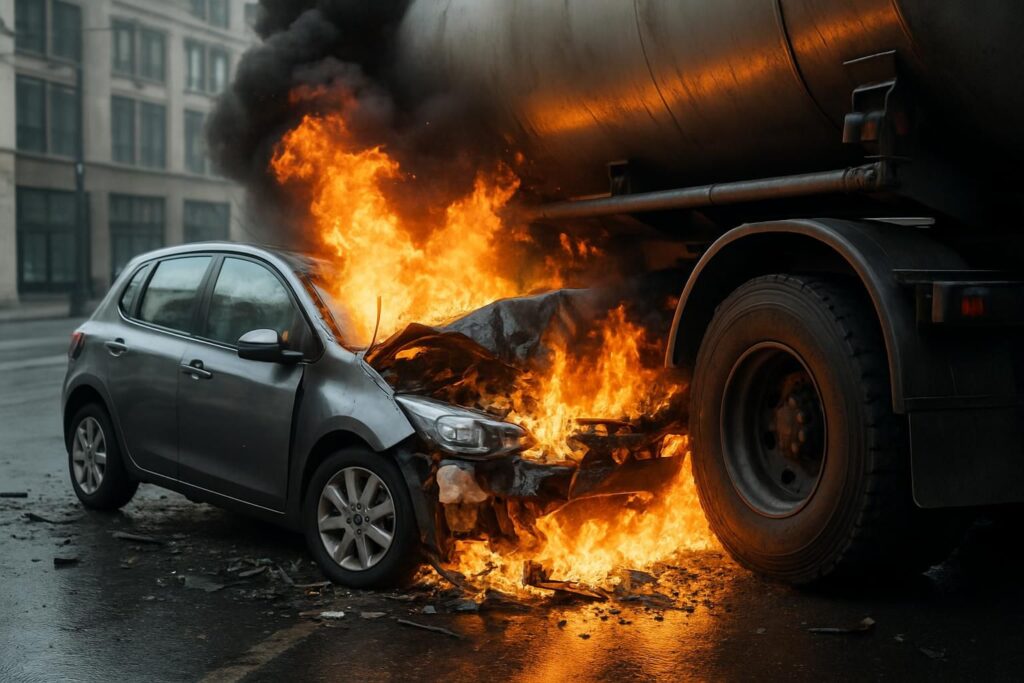
A rare violent accident left a strong impression on motorists on the A1 highway, when a car violently crashed into a heavy truck and then became wedged under it before catching fire. This spectacular impact, which mobilized significant emergency resources, illustrates the brutality that some road accidents can take despite technical advances in safety. On this often accident-prone section of the highway, this event once again highlights the major risks faced by motorists and heavy trucks, and raises crucial questions about the prevention and management of spectacular accidents involving light vehicles and trucks.
While the final toll could have been tragic, thanks to a rapid and well-organized response from emergency services, the consequences were somewhat limited. However, the fire that followed the wedging highlights the severity of ignition situations where time is critical to extract victims. This spectacular collision also raises a broad debate about the essential measures to be strengthened on busy construction sites and roadways to protect users’ lives and prevent future tragedies within the secured context of 2026.
Detailed analysis of a collision where a car becomes wedged under a truck and catches fire
The dynamics of an accident are often the result of a combination of several factors, whether human, mechanical, or environmental. In this case, the car, a BMW according to emergency reports, plunged beneath the frame of a refrigerated truck stopped on a fast lane. The impact was so intense that the hood and the two front seats were literally pulled under the heavy truck, a situation rarely observed but extremely dangerous.
This type of collision, where the light vehicle lodges under a heavy truck, is particularly feared by road safety experts. The tall structure of trucks often does not leave enough space to absorb the shock when the impact occurs at the rear, quickly turning the deformation zone of the light vehicle into a true prison for the occupants. A recent 2026 study recalls that this type of accident is among the deadliest on French roads, especially on heavily trafficked routes like the A1.
The exact circumstances of this collision have not yet been revealed, but initial analyses indicate a possible loss of control of the car, perhaps related to distraction or excessive speed. The interaction between the speed of the light vehicle and the massive weight of the truck generated a brutal impact followed by immediate ignition, requiring a rapid and coordinated intervention from firefighters, specialized in delicate operations on heavy trucks.
The mechanical and human consequences of these spectacular collisions underline the crucial importance of passive and active safety systems, notably anti-wedging devices or the improvement of energy absorption limits on heavy vehicles. This accident, a striking example of the complexity of modern accidents, calls for a more intense reconsideration of safety standards on heavy and light vehicles, as well as behaviors adopted on roads with high traffic density.
The crucial role of emergency services and interventions in the face of a vehicle fire accident
During a collision where a vehicle catches fire, rescue teams play a vital role in saving lives and controlling the fire. Here, firefighters were alerted immediately and deployed means adapted to this critical situation: extinguishers, high-pressure hoses, and extrication equipment to extract victims quickly despite the extreme deformation of the car under the truck.
The scenario of a wedged and burning vehicle requires careful management of priorities: extracting passengers while preventing the rapid spread of fire to other parts of the truck or nearby vehicles. Specific training for heavy truck fires is indispensable for firefighters, who must also face the complexity of chemical reactions related to fuel and transported materials.
In 2026, coordination among various emergency services – police, firefighters, SAMU – appears as an essential condition to limit the number of victims in these rare yet visually and humanly impactful situations. Emergency responders on this highway were able to close lanes as quickly as possible, thus reducing the risk of secondary collisions and facilitating the work of the teams.
Beyond evacuating the injured, post-accident management now includes clear communication to the public and media, often present on-site, to avoid the spread of false information and limit witnesses’ stress. This integrated approach, fundamental in the national road safety policy, gains efficiency as surveillance and intervention technologies evolve.
Human factors in collisions between cars and trucks: common errors and prevention
Each accident of this nature partly reveals flaws in driving behavior management. Several recent studies have highlighted that collisions between cars and heavy trucks are often caused by a combination of human errors, such as distractions, failure to respect safety distances, or poor anticipation of maneuvers.
Concentration while driving on arteries like the A1 highway is paramount, especially given the massive presence of trucks, which require more space to turn, brake, or change lanes. In the case studied, although the exact circumstances remain to be confirmed, the car’s speed, reduced attention, or an inappropriate maneuver could have caused the crash.
To reduce these risks, authorities are multiplying awareness campaigns targeting both private and professional drivers. Technological devices, such as automatic emergency braking now equipped on many vehicles, demonstrate their effectiveness but need to be complemented by constant vigilance from users.
Here is a list of frequent human errors leading to serious collisions with trucks:
- Underestimation of safety distance – a key factor to avoid rear-end collisions.
- Poor management of blind spots – especially for drivers who do not respect the limited visibility of heavy trucks.
- Distraction or fatigue – significantly reducing reflexes.
- Excessive speed – increasing the severity of any collision.
- Poor anticipation of braking – especially in the case of abrupt slowing by trucks.
Prevention measures also include the development of reinforced, accessible, and adapted training, particularly in a context where traffic on major French highways remains dense and sometimes chaotic. Beyond automatic tools, the human factor retains a key role in preventing the dramatic accident between truck and car from recurring.
Technologies and ongoing efforts to improve safety during collisions between heavy trucks and cars
Given the persistence and seriousness of accidents involving heavy and light vehicles, the automotive industry and authorities are investing massively in innovations aimed at strengthening safety. In 2026, several technologies are being deployed to reduce the risk of spectacular collisions like this car wedged under a truck.
Among these advances are automatic braking systems combined with proximity sensors, capable of detecting impact risks more quickly and acting within fractions of a second. Moreover, new protective structures for the undersides of trucks are being tested to prevent light vehicles from slipping under heavy trucks in frontal or rear collisions.
Highway construction sites also benefit from safety improvements, with innovative devices to clearly signal work zones or slowdowns. These innovations contribute to drastically reducing the accident rate on routes comparable to the A1. Efforts are also being made to provide more training to professional drivers on handling and respecting safety rules in mixed traffic conditions.
This context is reflected in recent news, notably in champagne.news/innovation-securite-chantiers/”>the rise of safety innovations on road construction sites, where user protection has become a priority issue. The combination of new technologies and better training could thus reverse this dramatic trend of spectacular accidents involving cars and trucks.
Social and legal consequences of spectacular collisions between cars and trucks
Beyond material and human impacts, accidents like those in which a car is wedged under a truck before catching fire raise questions about their social and legal repercussions. Victims, often seriously injured or sometimes deceased, face a long rehabilitation path along with complex responsibility issues often difficult to establish.
Post-accident investigations rely on thorough analysis of the circumstances and may involve various parties: drivers, transport companies, highway managers. The justice system must then unravel the chain of events leading to the crash to assign responsibilities and apply appropriate sanctions, or even trigger regulatory reforms when necessary.
Socially, these spectacular collisions cause strong emotions in local communities, often marked by the loss of loved ones or suffered sequelae. Continuous awareness of safety as well as support for victims’ families are recognized priorities to prevent these tragedies from recurring.
A significant example is presented within the framework of dramatic accidents recorded in the Champagne region: the site champagne.news/tragedie-routiere-marne/ regularly highlights the social weight of these events on families, while calling for the strengthening of prevention mechanisms. These human and legal aspects, too often overshadowed by media whirlwind, are nonetheless at the heart of the fight against road insecurity.
What are the first actions to take in the event of an accident with ignition?
It is crucial to immediately alert emergency services, move witnesses away from danger and, if possible, use an extinguisher to limit the spread of fire until firefighters arrive.
How to prevent collisions between cars and trucks on highways?
Maintaining a strict safety distance, remaining vigilant regarding heavy trucks’ blind spots, and adjusting speed according to traffic are essential actions to reduce risks.
Why does a car often wedge under trucks during a collision?
This situation is explained by the height of heavy trucks’ bumpers and the lack of effective anti-wedging devices on some vehicles, making the light vehicle trapped under the truck.
What is the role of technological innovations in road safety?
Technologies like automatic emergency braking, proximity sensors, and improved vehicle structures offer enhanced protection that can significantly reduce the impact of accidents.
What to do if you witness a spectacular accident?
You should secure the area without putting yourself in danger, call emergency services quickly, and follow rescue instructions while providing first aid if possible.