
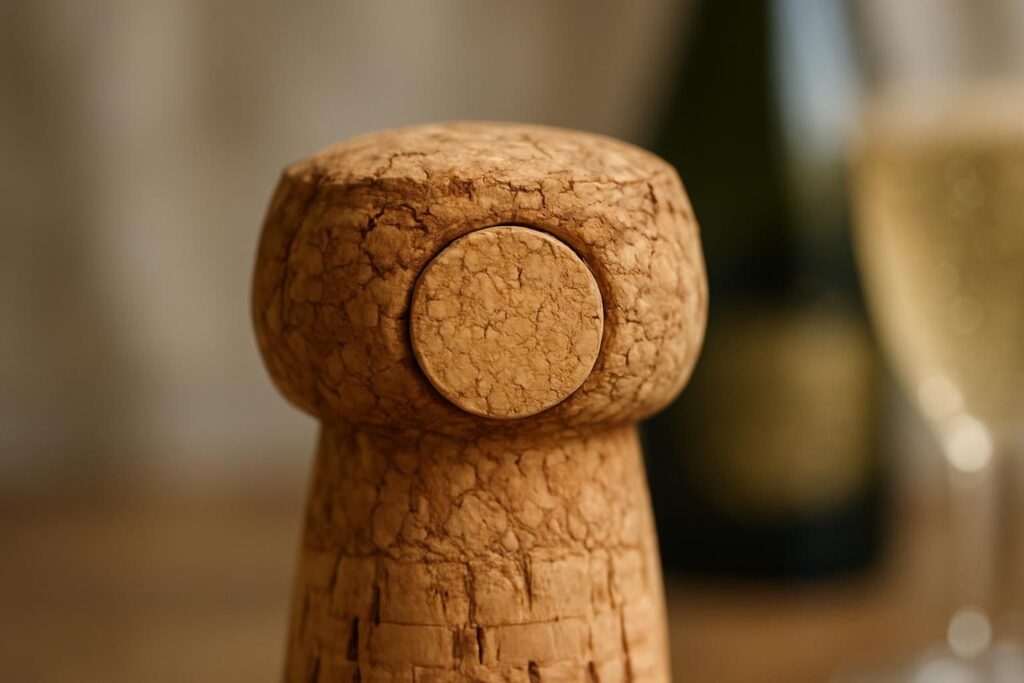
When a bottle of champagne is uncorked, attention naturally turns to the cloud of bubbles that gracefully escapes. Yet, a crucial detail often goes unnoticed: the small cork disc nestled at the base of the stopper. This discreet component, which most consumers consider just a random piece of cork cut out, actually plays a fundamental role in the preservation of champagne. Its function goes far beyond a simple closure; it is one of the invisible guardians of the quality and effervescence of the precious beverage. Nevertheless, the mystery surrounding this disc remains intact, while its importance in sealing and flavor preservation is crucial.
This disc is an integral part of a specific design that distinguishes the champagne stopper from its counterpart intended for still wines. It ensures that the bottle withstands an exceptional internal pressure, reaching on average 6 bars — a constraint much higher than that encountered in the majority of other drinks. The complexity of its manufacture and its thoughtful assembly reveal expertise rooted in history, dating back to the 17th century. The robustness and flexibility of the natural cork used for this disc demonstrate a delicate technical balance intended to maintain effervescence while ensuring maximum protection against oxidation.
Worldwide, this particular practice also highlights contrasts. The natural cork used for this disc mainly comes from Portugal, the undisputed leader of this raw material. Moreover, different wine regions adopt varied approaches, influenced by industrial constraints or aesthetic choices, but none have completely abandoned this piece with such a delicate role. Navigating between tradition and innovation, understanding this cork disc sheds new light on the often overlooked mechanisms of champagne bottle manufacturing and preservation.
The specific composition of the champagne stopper: a meticulous assembly
The champagne stopper is not limited to a single piece of cork, unlike the traditional stopper used for still wines. It is the result of an ingenious assembly, consisting of one or two natural cork discs glued at the base, topped by a part made of agglomerated cork, derived from compressed granules. This complex structure responds to very specific needs related to the closure of bottles subjected to high internal pressure.
The famous natural cork disc represents the only direct interface with the liquid. This characteristic imposes strict properties on this disc: it must be both watertight, elastic to fit perfectly onto the neck, and resistant to pressure. The latter, which can reach 6 bars, is equivalent to that of a truck tire. To meet these requirements, only natural cork has a unique compression capacity, able to reach 50% of its volume without losing its flexibility. This shape memory guarantees that the stopper remains constantly in contact with the glass, preventing any leakage of gas or unwanted oxygen.
The body of the stopper, generally made of agglomerated cork, fulfills other important functions. Initially, the stopper is cylindrical in shape, which facilitates its forced insertion into the neck. Then, over time, the top expands outside the bottle, creating the characteristic mushroom shape. As for the bottom part that remains inserted, it preserves the integrity of the natural cork disc, ensuring continuity of the seal. This structural duality is therefore a balanced combination of flexibility and resistance, each part playing a complementary role in protection against oxidation and bubble preservation.
This engineering is all the more fascinating since its design dates back to an era when technical means were rudimentary, demonstrating the ancient expertise of the masters of the Champagne region. The evolution since the 17th century has not only focused on the quality of the wine but also on that of the vinicultural equipment such as the stopper. This small cork disc, although discreet, embodies a fundamental pillar of this innovation.
Natural cork: an irreplaceable material for perfect tightness
The choice of this natural cork disc within the champagne stopper is no coincidence. Indeed, no other material manages to reproduce the elastic and compressive properties of cork. This ability to compress up to half its volume while fully retaining its shape memory is unique, allowing a perfect seal when inserted into a neck often narrower than the diameter of the initial stopper.
This elasticity ensures a watertight seal without fail, preventing leaks of carbon dioxide, essential for preserving the characteristic effervescence of champagne. Furthermore, the liquid-impermeable nature of cork prevents any contamination or alteration of the wine through contact with external agents. Natural cork thus acts as a true protective shield, also limiting the risk of oxidation that could harm the delicate aromas and finesse of the wine.
The glue used to assemble the natural cork discs with the agglomerated cork is also rigorously chosen to prevent migration of compounds into the wine. The disc thus forms a hygienic barrier preventing the champagne from being affected by residues of the stopper.
This point is crucial because in other wine regions or sparkling wine-producing countries, there are sometimes stoppers made entirely of agglomerated cork, or even of injected plastic. These more economical alternatives cannot ensure such longevity nor preservation of the organoleptic characteristics of the wine. The risks of cork taint increase notably.
Portugal, the main global supplier of cork, provides the majority of materials used for French stoppers, including those dedicated to champagne. The raw material thus undergoes an important journey before reaching the Champagne cellars, reflecting a supply chain where quality is paramount to guarantee the efficiency of a component as small as it is crucial.
Examples of alternatives used in other countries
- Australia and South Africa: frequent use of stoppers made entirely of agglomerated cork, sometimes leading to poorer preservation and sensory defects.
- United States: experiments with injected plastic stoppers imitating the mushroom shape, but without matching the natural flexibility of cork.
- Germany: adoption of a hybrid system with reinforced metal capsule, a more reliable industrial practice but less prestigious visually.
Internal pressure: a technical challenge for sealing champagne bottles
Champagne is a unique sparkling drink whose internal pressure is a major complexity factor for its preservation. Emerging as a technical innovation since the time of the monk Dom Pérignon in the 17th century, the stopper had to adapt to extreme constraints.
The carbon dioxide released during secondary fermentation in the bottle generates internal pressure that can reach 6 bars, a considerable force against which the stopper must resist. The natural cork disc glued at the base plays a leading role here, establishing the necessary seal between the wine and the outside. Without this piece, the gas would escape quickly, causing the loss of bubbles and wine degradation through oxidation.
The application of the muselet, the small metal cage holding the stopper in place, completes this protection. The muselet exerts an opposing pressure preventing the stopper from popping out under the effect of the internal force. This combination between the natural cork disc and the muselet is therefore the culmination of a synergy between natural materials and vinicultural equipment, essential for the drink to reach consumers in its optimal state.
Over aging, the lower part of the stopper, incorporating the disc, remains compressed in the neck, while the head of agglomerated cork swells during extraction and its stay outside the glass. This dynamic explains the characteristic mushroom shape and reflects an evolutionary process as aesthetic as it is functional.
The history and heritage of the natural cork disc in Champagne tradition
The cork disc glued at the base of the champagne stopper is also the heir of an ancestral know-how whose roots are lost in the vineyards of the region. It was Dom Pérignon, the emblematic Benedictine monk, who popularized the use of natural cork in the 17th century, abandoning oiled hemp pads that were poorly sealed and often defective.
This revolution then significantly improved wine preservation, promoting the appearance of controlled effervescence – still rare at the time. The current manufacture of stoppers, although modernized, remains faithful to this initial principle: a pointed part in natural cork ensuring a perfect seal, topped with a more economical agglomerated body.
The “mushroom” shape, the result of pressure exerted and time, has become a globally recognized symbol. It testifies not only to an important step in bottling but also to a well-thought-out design optimizing the finished product’s quality. This technical detail proves that every element of the bottle closure is designed to balance tradition and modern market requirements.
Finally, this exclusive manufacture also impacts the perceived value of champagne among enthusiasts and connoisseurs. The presence of this natural cork disc is a guarantee of quality, ensuring that the wine will retain its aromas and freshness intact until tasting.
Essential elements to remember about the natural cork disc in the champagne stopper
This small natural cork disc, a true centerpiece within the champagne stopper, plays an unknown yet crucial role in the preservation of flavors and protection against oxidation. Its technical quality allows each bottle to preserve its effervescence and finesse in the long term.
Here are the key points that perfectly illustrate its importance:
- Tripartite structure of the stopper: combination of natural cork discs and agglomerated cork to maximize flexibility and resistance.
- Exclusivity of natural cork: unique material capable of ensuring compression and elasticity suited to high pressure.
- Sanitary role: hygienic barrier preventing unwanted contact between glue, agglomerate, and wine.
- Response to internal pressure: maintaining tightness despite pressure reaching 6 bars in the bottle.
- Historical heritage: technical legacy dating back to the 17th century, enhanced by the image of Dom Pérignon.
- International differences: variations worldwide in the wine industry according to materials used and industrial choices.
The natural cork disc is therefore far from being a simple accessory; it is the silent guarantor of quality and champagne’s lifespan.
Why is a natural cork disc used in the champagne stopper?
This natural cork disc ensures perfect tightness thanks to its unique capacity for compression and elasticity, essential to contain the high pressure of champagne while preserving its taste.
What is the difference between natural cork and agglomerated cork in a stopper?
Natural cork, used in the discs at the base, offers better elasticity and impermeability, while agglomerated cork forms the upper part that gives the stopper its shape but is less effective in direct contact with the wine.
Can natural cork be replaced by other materials?
No material perfectly reproduces the properties of natural cork, especially its shape memory and its ability to adapt to high pressure, making its replacement difficult for ensuring optimal champagne preservation.
How does the stopper resist the internal pressure of champagne?
The natural cork disc compresses in the neck, creating a reliable seal, while the metal muselet holds the stopper in place to counter the internal pressure that can reach 6 bars.
What are the risks if the cork disc is absent or of poor quality?
Without this disc, the risk of gas leakage, oxidation, and contamination increases, compromising the preservation of champagne and altering its delicate flavors.