
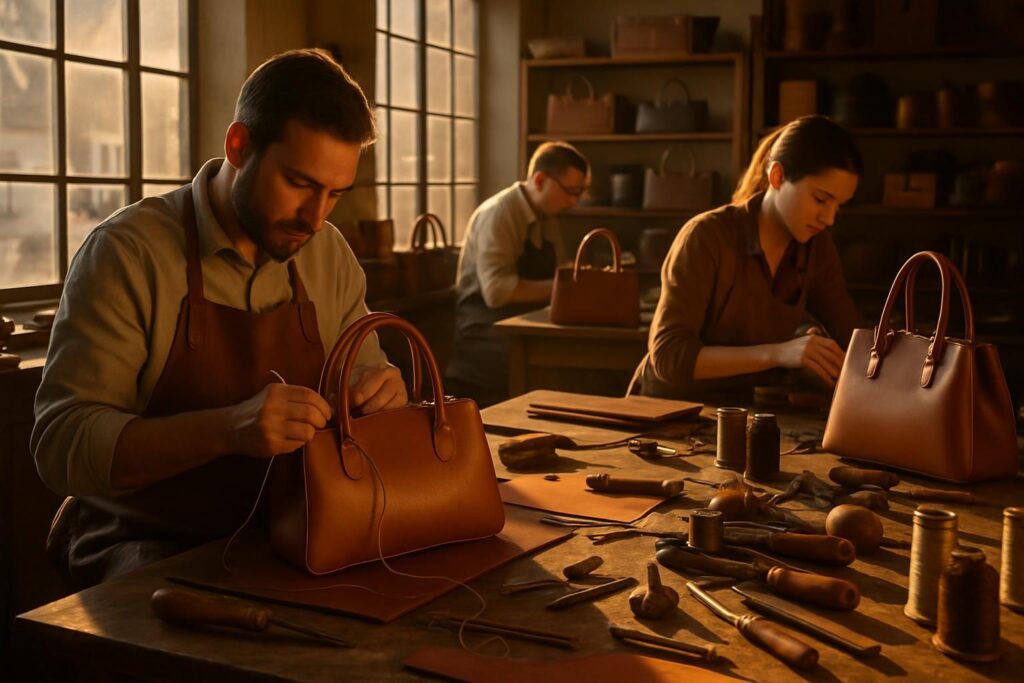
In the shadow of the famous vineyards where champagne sparkles the reputation of L’Aube, a less publicized but equally fundamental sector deeply animates the local economy: luxury leather goods. This Champagne territory has established itself over the years as a strategic crossroads of artisanal manufacturing and high-end subcontracting for major Parisian houses. Behind discreet facades, leather workshops deploy exceptional expertise, perpetuating an industrial tradition at the heart of French luxury and directly contributing to the national value chain. The economic weight of these manufacturers actually surpasses that of the vineyard, revealing a unique duality within the same department.
In search of excellence, companies such as Atelier d’Ariane and Manufacture de l’Aube have developed based on the industrial foundations of the Troyes hosiery industry, now redirected towards meticulous leatherwork. Their collaborations with prestigious luxury brands illustrate both the complexity and richness of the local artisanal fabric. L’Aube shines not only through its golden flutes and sparkling champagnes, but above all through the tangible quality of its leather goods productions, embodying the subtle marriage between artisanal tradition and industrial modernity. This overview explores the specificity of this little-known industry, highlighting its driving role in the influence of French luxury.
Leather goods in L’Aube: artisanal expertise in the service of French luxury
In L’Aube’s local economy, leatherwork is not limited to the simple creation of items. Every piece made in the department’s workshops bears witness to meticulous craftsmanship, rooted in a tradition anchored in the precise gestures of cutting, sewing, and finishing. This work often takes place out of the spotlight, within discreet workshops that prefer quality over visibility.
In Troyes and its surroundings, leather goods benefit from a strong industrial heritage. Once a thriving center for hosiery, this region has managed to transform its former textile production units into leather workshops, specialized in the manufacture of fine and sophisticated pieces. Highly skilled artisans thus work on accessories such as bags, wallets, or watch straps, meeting the precise demands of French luxury houses. This local know-how, the result of intergenerational transmission, maintains impeccable quality that wins the approval of the biggest names in the sector.
L’Aube’s artisans embody a full range of skills, from meticulous tanning to personalized small-series production, ensuring a flexibility that large central manufacturers cannot always offer. Thus, they combine manual traditions and innovative techniques to meet sometimes very technical specifications. This excellence also relies on strong complementarity among the various leather goods houses, which maintain positive emulation, consolidating a local industry with demanding standards.
Leather mastery is accompanied by strict requirements on the origin and quality of materials, often selected from the best European tanners. This rigor in the supply chain helps strengthen the added value of finished products. The result is a production where every detail counts, from the selection of each skin to the last invisible stitch, reflecting an artisanal identity recognized worldwide.
The subcontracting sector in L’Aube: a strategic link for Parisian luxury houses
Subcontracting is the pivot on which much of the French luxury industry in leather goods rests. L’Aube, through its dense artisanal fabric and undisputed expertise, has become a preferred platform for brands wishing to outsource part of their production while ensuring a high level of quality.
Relying on former industrial infrastructures, companies from L’Aube now position themselves as privileged subcontractors, particularly for major Parisian houses such as Hermès, Louis Vuitton, and Chanel. These brands value the essential role of regional workshops which, behind the scenes, shape a significant share of the exceptional pieces worn on international runways.
This collaboration is the fruit of a subtle balance: luxury houses keep their creative capacity and marketing control while L’Aube’s workshops bring their technical mastery and industrial responsiveness. This multi-level managed chain requires meticulous coordination, where communication and mutual trust are key factors. Leather goods subcontracting thus becomes both a vector of territorial development and a significant economic lever.
The scale of this activity also allows for impressive figures in terms of local employment. According to recent statistics, the leather and leather goods sector far exceeds the more visible economic impact of the wine sector in terms of direct employment. Indeed, although champagne is the emblem of the department, it only represents 3% of salaried jobs, while leather goods and subcontracting around leather account for a much larger share.
The rise of these workshops has even made possible, in some cases, the creation of hundreds of jobs in the territory, helping to stabilize the local economy through adapted training and recruitment. Links with specialized schools promote the transmission of know-how and guarantee the future of a profession at the heart of luxury.
Structuring industrial projects: Manufacture de l’Aube and the rise of high-end leather goods
In 2024, the inauguration of Manufacture de l’Aube marked a decisive step in strengthening the luxury leather goods cluster. Located in Sainte-Savine, near Troyes, this innovative factory signals a clear ambition: to reinforce local industrial presence in a sector usually concentrated around the capital. Through this initiative, the house Jean Rousseau, specializing in small leather goods, positions itself as a major player in the manufacturing of high-end items, relying on exceptional regional expertise.
Manufacture de l’Aube also symbolizes the modernization and organization of an often fragmented artisanal fabric. It optimizes production thanks to efficient industrial tools while preserving qualitative manual work. This hybrid model, combining tradition and innovation, perfectly meets the expectations of luxury clientele, demanding quality but also attached to the authenticity of pieces.
With the announced creation of 200 jobs, this manufacture very positively impacts the local economy, while revalorizing an industry fully integrated into the dynamics of “France Terre Textile.” This label promotes the excellence of regional know-how in textile and leather manufacturing, highlighting the central place that L’Aube holds in the supply chain of French luxury.
Moreover, Manufacture de l’Aube is one example among others of the territory’s dynamism, attracting companies looking to benefit from a qualified workforce, specialized training, and proximity to complementary industrial partners. This virtuous circle contributes to French competitiveness on a globalized market where the quality and traceability of production become decisive criteria.
The economic and social impact of a discreet but powerful artisanal sector in L’Aube
Despite its discreet profile, the leather goods sector in L’Aube carries significant weight in the local economy. It contributes not only to job creation but also to the valorization of the territory beyond its borders. This sector, often unknown to the general public, constitutes a real lever for economic and social development.
Training plays a prominent role: thanks to dedicated schools and specialized institutes created notably by actors like Atelier d’Ariane, a pool of talent is constantly renewed. This allows responding to industrial needs while maintaining a high level of requirement in technical mastery. The link between training and business thus reinforces the sector’s sustainability and competitiveness.
This artisanal industry, through its demanding nature and the nobility of the materials used, promotes interesting diversification of local jobs. It offers varied professional prospects ranging from manual confection to quality management, including design and logistics. By consolidating this network, the L’Aube region positions itself as a trusted partner for luxury houses, while guaranteeing a sustainable balance between tradition and innovation.
It is remarkable that this economic weight does not necessarily lead to strong media exposure. This paradox between the international notoriety of finished products and the relative anonymity of workshops constitutes a specificity to preserve, underlining the strength of an industry based on discretion, quality, and authenticity. These values translate into an unwavering commitment from artisans and subcontractors to perfection, generating essential added value for French luxury.
Among the notable initiatives in recent years, one can mention:
- The takeover and consolidation of workshops historically linked to hosiery.
- The integration of specialized leather goods training into local curricula.
- The creation of partnerships between artisans and major houses to facilitate innovation.
- Sustainable development integrated into the production chain, with increased attention to the eco-responsibility of materials.
- The promotion of the “France Terre Textile” label highlighting regional skills and industrial quality.
This video perfectly illustrates the meticulous artisanal manufacturing process of high-end leather goods, focusing on traditional techniques used in L’Aube’s workshops.
Training and innovation: pillars of the future of leather goods and subcontracting in L’Aube
Faced with the contemporary challenges of the luxury sector, specialized training is a fundamental element to preserve the quality and competitiveness of L’Aube’s workshops. Atelier d’Ariane, a pioneer in this field, established a dedicated school to transmit the exceptional skills indispensable to fine leather goods. This rigorous oversight guarantees not only the acquisition of technical skills but also awareness of the history and ethics of artisanal production.
Technological innovations also play a growing role. They complement manual work, without ever replacing it, offering more precision and efficiency. This fine balance allows increasing production capacities while respecting the integrity of the pieces made. For example, the use of numerically controlled machines combined with meticulous manual inspection optimizes processes and limits defects.
This synergy between advanced training and controlled innovation helps integrate the department into the overall French luxury sector. It ensures the transmission of a unique heritage while adapting the industry to current and future market demands. The example of Manufacture de l’Aube illustrates this rise well, with projects oriented towards sustainable development and strengthening local skills.
The prospects opened by this dynamic are accompanied by increased demand for personalized and small-series productions, a segment where local workshops excel. This high-end positioning, combined with industrial flexibility, gives L’Aube an essential role in the French luxury chain, a sustainable and excellence-oriented pillar.
This video highlights the integration of advanced technologies within high-end leather goods workshops, thus confirming the complementarity between tradition and innovation in the sector.
Quel est le rôle de l’Aube dans la maroquinerie du luxe français ?
L’Aube est un territoire clé de la fabrication artisanale et de la sous-traitance pour la maroquinerie de luxe. Elle abrite des ateliers spécialisés qui fournissent des pièces de haute qualité aux grandes maisons parisiennes, contribuant ainsi à la chaîne de valeur du luxe français.
Comment l’artisanat maroquinier contribue-t-il à l’économie locale de l’Aube ?
L’artisanat maroquinier génère une part importante des emplois locaux, bien plus que la filière Champagne en termes d’emplois salariés. Il soutient aussi un tissu industriel dynamique et favorise la formation et l’innovation dans la région.
Quelles sont les perspectives d’avenir pour la maroquinerie dans l’Aube ?
Le secteur mise sur la formation spécialisée et l’intégration d’innovations technologiques pour maintenir la qualité et la compétitivité. La demande croissante en produits personnalisés et en petites séries promet un avenir favorable.
Pourquoi la sous-traitance est-elle importante dans la filière maroquinerie ?
La sous-traitance permet aux grandes maisons de luxe de se concentrer sur la création et le marketing tout en bénéficiant du savoir-faire technique et de la production flexible des ateliers spécialisés de l’Aube.