
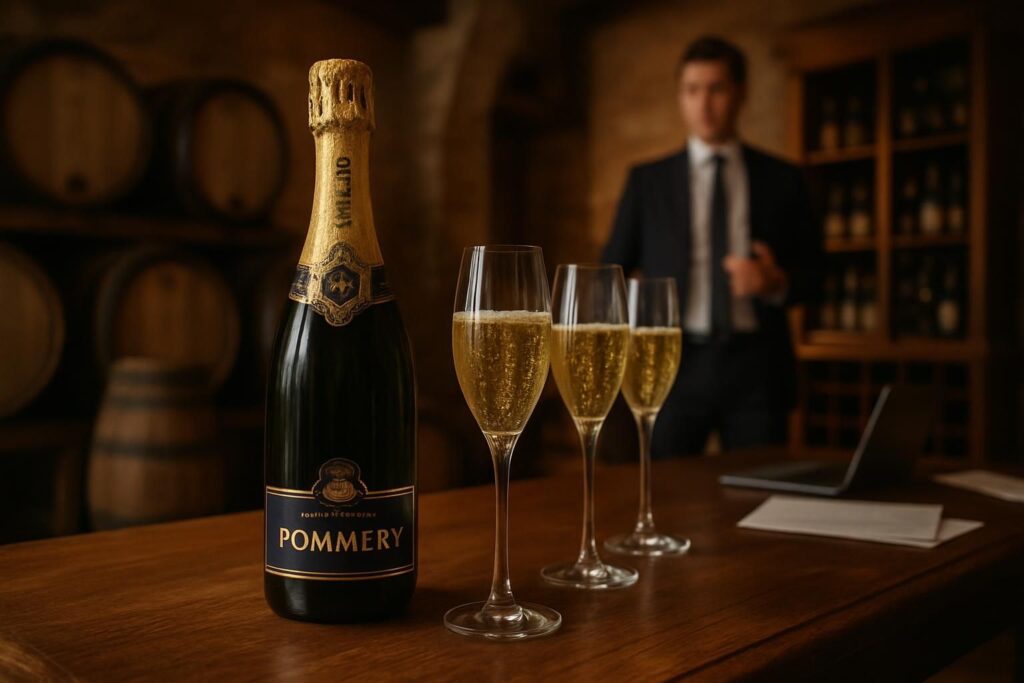
The Maison Pommery, a historic icon of the Champagne industry, is going through a major strategic period in 2026. Faced with significant debt and after several months of intense discussions, exclusive negotiations with the German sparkling wine giant, Henkell International, ended in failure. However, this setback did not compromise the financial restructuring momentum of this major Champagne group, which quickly mobilized its financial partners to secure its cash flow and future. In this complex context, Maison Pommery confirms its emblematic role in the global Champagne market while reflecting the requirement of a financial strategy adapted to the current production and distribution challenges, especially in the German market where competition is fierce.
This delicate period invites a deep reflection on the group’s economic model, its strengths, but also on the structural upheavals affecting the entire wine industry. By leveraging its multiple estates in Champagne, Provence, Camargue, and even in the Douro Valley in Portugal, the group manages to maintain a certain diversity of its activities, essential in a rapidly changing environment. These transformations force the sector to manage its financial flows with precision while continuing to innovate in the production and promotion of its vintages.
The stakes of the missed partnership between Maison Pommery and Henkell in the sparkling wine industry
The announced merger in June 2026 between Maison Pommery, renamed Vranken Pommery since January, and Henkell International had raised many hopes within the wine industry. Aiming to create a global player capable of competing with the biggest names in the sector, this alliance promised a powerful synergy. Henkell’s majority stake in Maison Pommery would have solidified the group’s commercial position in the very competitive German and global markets.
However, exclusive negotiations ended in late July without an agreement, illustrating the difficulties encountered in reconciling sometimes divergent interests between a German sparkling wine giant and a historic French group. The failure of this partnership raises questions about the compatibility of strategic visions and the governance arrangements envisaged. The complexity of integrating a Champagne house, steeped in centuries-old traditions, into the goals of a group with global ambitions must not be underestimated.
It is important to emphasize that this disagreement does not signify a final rejection of the discussions. Both entities remain open to future opportunities for exchanges, thus demonstrating a common will to adapt to the demands of a sector undergoing significant change. At the same time, this context reflects a tense economic climate for Champagne houses in 2026, where refinancing debts and ensuring financial sustainability become major priorities.
Strategic refinancing: behind the scenes of the agreement with financial partners
Following the failure of negotiations with Henkell, Maison Pommery quickly found a lifeline in refinancing to keep moving forward. It concluded a conciliation protocol with its main financial partners, securing a package of 42.8 million euros intended to cover the immediate needs of the group and those of nine integrated subsidiaries. This agreement covers the essential cash flow through June 2027, with an option to extend by an additional year, providing appreciable stability in a volatile context.
This refinancing operation goes far beyond a simple transfer of capital. It allows Maison Pommery & Associés to approach the 2026 harvest, anticipated earlier this year, with secured means to pay operational deadlines and calmly pursue the essential steps for producing quality champagne. Faced with the pressure producers endure due to price fluctuations and climatic challenges, this financial windfall represents insurance against the uncertainties of the annual viticulture cycle.
The protocol fits into a medium-term vision, aimed at reaffirming the group’s financial credibility with the market and investors. Maintaining control of the house over its various estates, notably in Provence and southern France, supports this pragmatic approach. This highlights the importance for traditional players to define adapted strategies to manage their debts while preserving their unique know-how, the foundation of distinctive offerings in the premium wine and champagne market.
Impact of the 2026 financial results on the future strategy of Maison Pommery
The first half of 2026 confirmed the fragile economic situation of the house. Revenue amounted to 95.7 million euros, recording a decrease of 12.4%, a notable trend for a traditionally robust sector. The 11.5% drop in champagne sales, the group’s hallmark, as well as the 30.2% decline in sparkling wines and Port in the “others” category, underline structural difficulties.
Conversely, wines from Provence and Camargue show encouraging signs with a slight increase of 1.7%. This relative success could steer Maison Pommery toward repositioning its product portfolio by betting on these territorial niches and ranges better suited to new consumer expectations. This diversification is a direct response to commercial challenges and economic uncertainties facing the wine industry.
These figures affect the governance and financial communication of the house, making a more agile policy imperative. For example, the late publication of the universal registration document, essential for account validation, highlights the complexity of financial operations. The ability to quickly adjust investment plans and to fully leverage the group’s assets, notably its varied vineyards and well-known brands such as Charles Lafitte or Rozès, will be decisive.
The challenges and perspectives of the German market following the negotiation failure
The German market, important for sparkling wine producers, represents a strategic field where presence and distribution are essential to establish international influence. Henkell International, leader in Germany, had a strong foothold capable of accelerating the spread of Maison Pommery’s champagnes, which would have constituted a powerful commercial lever.
With the halt of discussions, the French house faces the necessity of rethinking its approach to the German market without directly benefiting from Henkell’s network and infrastructure. However, this situation is not synonymous with definitive retreat but rather an adjustment of commercial strategy. It will have to rely on its intrinsic strengths, notably the quality of its products and its historical anchoring, while seeking new partnerships or logistical solutions capable of strengthening its access to this major market.
Furthermore, the increased competitive pressure caused by the contraction of overall Champagne sales calls for innovation in communication and marketing to capture a more demanding clientele, attentive to sustainable practices and the authenticity of wine houses. In the long run, Maison Pommery could consider resuming talks with Henkell or initiating other alliances but in a more favorable framework to preserve its identity and financial interests.
Diversified vineyard management: a lever for adaptation to financial volatility
Maison Pommery has a unique portfolio in France and internationally with four vineyards located in Champagne, Provence, Camargue, and in the Douro Valley in Portugal. This geographic diversity is a strategic strength, allowing risk mitigation linked to climatic and economic uncertainties specific to each region. The group manages several recognized brands in their segments, including
- Vranken and Pommery in Champagne, pillars of production and prestige,
- Charles Lafitte and Pompadour, offering distinct profiles,
- the Rozès range for Port wines, contributing to commercial diversity,
- and the Provence wines with Domaine Royal de Jarras as well as Château La Gordonne, appreciated for their finesse.
This network of productions allows the group to balance its revenue while remaining agile in response to market variations. This strategy also contributes to establishing a plural identity, blending Champagne tradition with innovations in Mediterranean and Portuguese wines. Facing financial volatility and constantly evolving consumer preferences, this diversification is an enlightening example of possible solutions to maintain the dynamism and competitiveness of a fundamental house in the sparkling wine universe.
Aware of the issues related to its refinancing and growth strategy, Maison Pommery illustrates the complex but imperative path groups in the wine industry must undertake. This case study is not isolated, and to understand all its dimensions, it is useful to consult the in-depth analysis of the challenges faced by Paul-François Vranken, emblematic leader in this sector.
{“@context”:”https://schema.org”,”@type”:”FAQPage”,”mainEntity”:[{“@type”:”Question”,”name”:”Pourquoi les nu00e9gociations entre Maison Pommery et Henkell ont-elles u00e9chouu00e9 ?”,”acceptedAnswer”:{“@type”:”Answer”,”text”:”Les discussions ont butu00e9 sur des divergences stratu00e9giques, notamment en matiu00e8re de gouvernance et de participation majoritaire, que les deux groupes n’ont pas ru00e9ussi u00e0 concilier avant la date du2019exclusivitu00e9.”}},{“@type”:”Question”,”name”:”Quelles sont les consu00e9quences financiu00e8res immu00e9diates pour la Maison Pommery ?”,”acceptedAnswer”:{“@type”:”Answer”,”text”:”La maison a su00e9curisu00e9 un financement u00e0 hauteur de 42,8 millions du2019euros via un protocole avec ses partenaires financiers, lui assurant une tru00e9sorerie stable jusquu2019en juin 2027.”}},{“@type”:”Question”,”name”:”Comment la Maison Pommery compte-t-elle gu00e9rer son du00e9veloppement sans Henkell ?”,”acceptedAnswer”:{“@type”:”Answer”,”text”:”Elle mise sur la diversification de ses vignobles et marques, tout en explorant de nouveaux partenariats commerciaux et en renforu00e7ant sa pru00e9sence sur les marchu00e9s clu00e9s, notamment en Allemagne.”}},{“@type”:”Question”,”name”:”Quel est lu2019impact de la crise sur les ventes de champagne et autres produits du groupe ?”,”acceptedAnswer”:{“@type”:”Answer”,”text”:”Le chiffre du2019affaires a reculu00e9 de plus de 12%, avec un recul marquu00e9 des ventes de champagne et des vins effervescents ; seuls les vins de Provence et Camargue ru00e9sistent lu00e9gu00e8rement.”}},{“@type”:”Question”,”name”:”Quelle place occupe le marchu00e9 allemand pour Maison Pommery ?”,”acceptedAnswer”:{“@type”:”Answer”,”text”:”Ce marchu00e9 constitue une zone stratu00e9gique prioritaire ou00f9 la maison cherche u00e0 renforcer sa distribution malgru00e9 lu2019u00e9chec des nu00e9gociations avec lu2019allemand Henkell.”}}]}Why did the negotiations between Maison Pommery and Henkell fail?
The discussions stumbled on strategic divergences, notably regarding governance and majority participation, which the two groups were unable to reconcile before the exclusivity date.
What are the immediate financial consequences for Maison Pommery?
The house secured financing amounting to 42.8 million euros through a protocol with its financial partners, ensuring stable cash flow until June 2027.
How does Maison Pommery plan to manage its development without Henkell?
It relies on the diversification of its vineyards and brands, while exploring new commercial partnerships and strengthening its presence in key markets, notably Germany.
What is the impact of the crisis on champagne sales and other group products?
Revenue fell by more than 12%, with a marked decline in champagne and sparkling wine sales; only the wines from Provence and Camargue hold up slightly.
What role does the German market hold for Maison Pommery?
This market constitutes a strategic priority zone where the house seeks to reinforce its distribution despite the failure of negotiations with the German Henkell.