
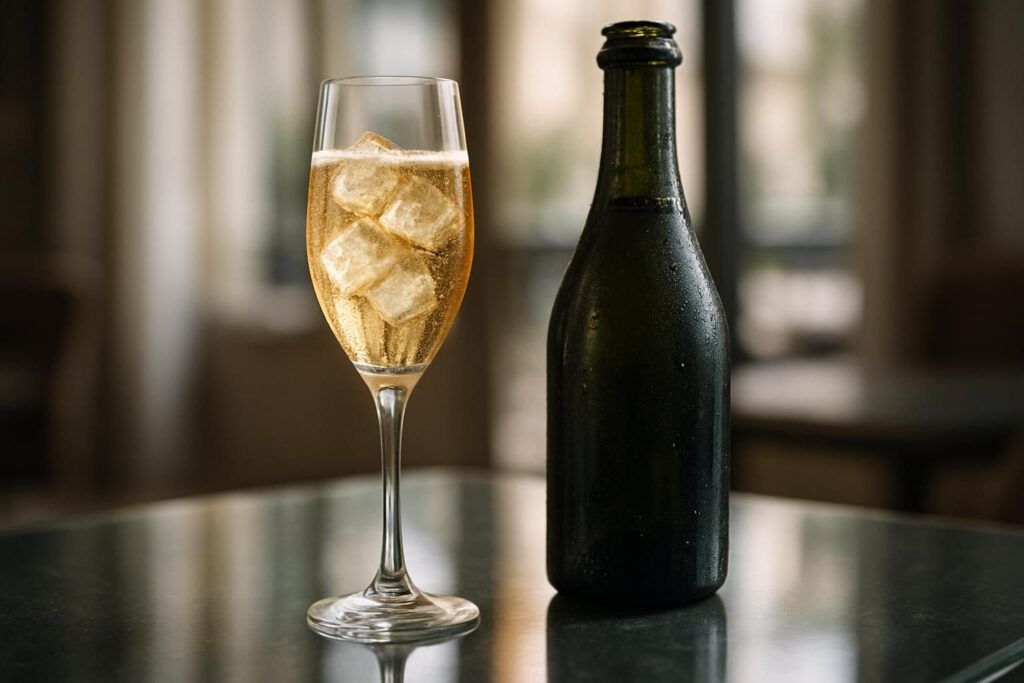
Champagne, a symbol of refinement and tradition, is an exceptional wine whose tasting is governed by precise rules, especially regarding service and temperature. However, in recent years, an unprecedented trend has emerged: savoring champagne with ice cubes. While this practice may initially surprise or even shock purists, it reflects an evolution in consumption habits, where the desire to explore new flavors and sensations takes precedence over conventions. Increasingly, prestigious houses now offer cuvées specially crafted to be enjoyed “on the rocks,” sparking the curiosity of enthusiasts. But what real influence do ice cubes have on the aromatic complexity, bubble finesse, and taste balance of champagne? And above all, does this innovative use preserve or even enhance the tasting experience without distorting it? These questions concern both amateurs and professionals at a time when demand for refreshing and light experiences is intensifying, especially during hot seasons. Far from anecdotal, these considerations touch the very essence of champagne, this noble and festive wine, whose cultural heritage is finding new life today.
Tasting champagne with ice cubes:Between firmly rooted tradition and assumed modernity
For several centuries, champagne tasting has been a ritual that respects precise codes. Traditionally served in flutes or delicate coupes, champagne is distinguished by an ideal temperature between 8 and 10°C. Below this, intense cold can numb the taste buds, masking subtle aromas and reducing the perception of bubble finesse. Conversely, too high a temperature causes the wine to lose its liveliness and balance. Thus, for connoisseurs, maintaining this temperature guarantees an optimal experience where every aromatic note is perceptible and the bubble bursts elegantly in the mouth.
However, the current context is changing these parameters: consumption is becoming more relaxed, less formal, and more focused on freshness and lightness. This evolution marks the emergence of a new approach, which involves adding a few ice cubes directly into the glass. This practice, formerly reserved for rosé or light white wines, is gradually gaining ground among champagne lovers, notably with the rise of cuvées specifically designed to be enjoyed “on the rocks.”
This innovation in champagne service goes beyond mere provocation and is associated with a stylistic and gustatory approach. Take for example the Ice Imperial cuvée by Moët & Chandon, a blend designed to preserve its aromas despite the inevitable dilution caused by melting ice cubes. This cuvée, recently launched in collaboration with Pharrell Williams, joins other creations like Rich from Veuve Clicquot or Royal Blue Sky from Pommery, which claim fruity and rounded profiles suited for a refreshing, even summery, tasting. These cuvées thus combine tradition and modernity, revisiting old codes to create new gustatory sensations.
For many experts, however, adding ice cubes to traditional champagne remains synonymous with sacrilege. Gabriel Veissaire, head sommelier at Meurice, points out that this dilution alters the intrinsic composition of the wine. This leads to a notable reduction in aromatic intensity and modifies the delicate balance between the bubble, structure, and length on the palate. Nevertheless, when champagne is made with the intention of allowing ice cubes, this practice should be considered not as a transgression but as a redefinition of usage, in line with new, less formal consumption moments.
How do ice cubes change the flavor and texture of champagne during tasting?
The presence of ice cubes in the glass influences not only temperature but also the perception of flavors and mouthfeel. The first noticeable impact is the progressive dilution of the wine, as the melting of ice cubes adds an aqueous volume that softens the blend while altering its density. This addition of water changes the relationships between aromatic components, resulting in a decrease in gustatory intensity and a reduction in complexity. Fineness and structure are weakened, and the persistence of flavors fades more quickly from the mouth.
However, ice cubes also have the advantage of accentuating perceived freshness. In a classic tasting, temperature is crucial to balancing the liveliness of champagne. With ice cubes, the cold sensation is more pronounced, which can provide a very refreshing effect much appreciated during hot periods or prolonged outdoor aperitifs. This freshness helps mask acidity and can reveal more pronounced fruity tones. For example, in a rosé champagne, red fruit notes stand out more on the rocks, while in a white, aromas of peach and grape emerge more distinctly.
Furthermore, the texture of the bubble changes profoundly: the effervescence becomes less present, less aggressive, offering a softer, velvety sensation. While for some connoisseurs this reduction in bubbles represents a loss, for others it creates a more accessible and relaxed tasting. It is therefore a qualitative transformation that shifts the boundaries of the traditional experience toward a lighter and more playful approach.
However, the question of dilution leads to consideration of the origin and dosage of champagne consumed with ice cubes. Cuvées specifically designed for this purpose generally feature a higher sugar dosage, up to 45 grams per liter for Ice Imperial, to compensate for the diluting effect of the ice. This strategy preserves sufficient aromatic richness even after several minutes of tasting, while offering a refreshing balance without drying out.
- A reduction in aromatic intensity due to gradual dilution by the ice.
- An accentuation of perceived freshness which enhances the thirst-quenching pleasure.
- A modification of the bubble, with softened effervescence less prominent in the mouth.
- Amplified fruity notes on rosé and white champagnes suited for this.
- A higher sugar dosage necessary to maintain balance despite the presence of ice.
Some pioneering champagne houses in the use of ice cubes
In the dynamic landscape of champagne houses, some stand out for their boldness in revisiting classic consumption styles by offering champagnes tailored to be tasted with ice cubes. Moët & Chandon is undoubtedly the most emblematic house in this category, with its Ice Imperial cuvée, whose conception dates back to reflections started as early as 2011 around an optimized blend. The goal was to propose an experience where dilution by ice does not compromise the wine’s overall harmony. Their blending work notably favors a specific pinot noir, a pinot meunier between 30 to 40%, and a chardonnay between 10 and 20%, accompanied by a dosage of 45 grams of sugar per liter. The result is a round and fruity champagne able to maintain its refinement even served “on the rocks.”
Moreover, other houses like Veuve Clicquot with its Rich cuvée or Pommery who created Royal Blue Sky have adopted a similar approach. These champagnes, more accommodating to ice cubes, offer an accessible alternative, adapted to new consumption modes, especially among a young audience in search of gustatory innovations. This phenomenon also fuels a diversified market, similar to innovations observed in other wine regions, such as Burgundy, where heritage recognition has encouraged contemporary approaches, illustrated by events like the upcoming Grande Champagne Expo Fair.
These pioneering houses thus contribute to creating a new use for champagne, shifting the balance between tradition and conviviality: a “champagne on the rocks” that can approach a refreshing aperitif drink, perfect for informal and festive moments. Through this trend, champagne opens itself to other experiences, without fully renouncing its roots of excellence and prestige.
Temperature and service: how to optimize champagne tasting with ice cubes?
The tasting temperature remains a cardinal factor in the champagne experience, whether served pure or with ice cubes. For classic champagne, the recommendation is to keep the wine between 8 and 10°C. Below this, aromatic capacities are reduced by excessive cold, while above, the wine can lose its liveliness and structure. Serving with ice cubes modifies this usual framework as it combines direct cooling and gradual dilution as soon as the ice cubes start melting in the glass.
To master this experience, it is above all advisable not to pour an excessive amount of ice cubes to preserve a balance between freshness and dilution. A tip is to favor large or specially designed ice cubes that melt slowly to avoid too rapid dilution. The resulting temperature can then fall below 6°C, which radically changes the perception of liveliness and aromas, with a marked amplification of the refreshing sensation, especially appreciated during hot seasons.
Another essential point is preparing the champagne before service. Placing the bottle in a bucket of ice water, a mix of water and ice cubes, ensures uniform cooling and avoids thermal shocks that could alter the wine’s quality. This traditional method guarantees an optimal thermal balance and ideally prepares the champagne for tasting, whether or not followed by the addition of cubes in the glass. For homogeneous freshness, cooling in the refrigerator for 3 to 4 hours can also suffice.
Finally, some sommeliers recommend reserving cuvées designed to be consumed with ice cubes for more relaxed or festive moments, where roundness of flavors and lightness take precedence over complexity and aromatic precision. The service, temperature, and quality of the ice cube then become essential elements to make the most of this unprecedented and offbeat experience, which does not necessarily tarnish refinement but transforms it.
- Use large ice cubes to slow dilution and preserve the balance.
- Pre-chill the bottle in a bucket with ice cubes and water to avoid thermal shocks.
- Control the amount of ice in the glass to harmonize freshness and dilution.
- Favor champagnes made for tasting with ice cubes, with an appropriate dosage.
- Accompany this tasting with convivial and relaxed moments to enhance the experience.
The impact of ice cubes on the transmission of know-how and champagne heritage
The introduction of ice cubes into champagne tasting illustrates a fascinating example of the tensions between innovation and tradition that cross the wine world. Champagne, rooted in a terroir and a rich history, represents much more than just a wine: it is a living heritage, recognized for its complexity and refinement. The place of ice cubes thus raises questions about how to transmit this know-how while embracing new practices.
The coexistence of tradition and modernity manifests in initiatives by certain schools and houses during cultural or educational events, such as the Intergenerational Champagne Olympiads, where changes in consumption trends are exhibited and discussed. These meetings promote understanding of issues related to preserving sensory heritage while integrating innovative proposals aimed at broadening the audience and reinventing codes.
Moreover, the dissemination of these practices also contributes to the valorization of champagne on an international level. For example, the association of prestigious houses with contemporary artists, as is the case at Moët & Chandon, opens unprecedented perspectives on wine communication. This allows maintaining a delicate balance between respecting history and adapting to the expectations of a younger audience sensitive to freshness, conviviality, and creativity.
Finally, these tensions underline the importance for professionals to continue relying on rigorous expertise in handling key notions such as temperature, aromas, and structure. It is only through this know-how that a true redefinition of tasting modes can occur, which does not alter the noble and refined image of champagne. In terms of sensory experience, the challenge is to balance tradition and innovation to satisfy contemporary palates without betraying the soul of the terroir. More information on innovative strategies is detailed in this article devoted to the expansion of champagne houses and their evolutions.
Is champagne with ice cubes suitable for all types of cuvées?
No, it is especially recommended for champagnes specifically designed for this use, generally dosed with higher sugar levels to maintain balance despite the dilution.
Do ice cubes permanently alter the aromas of champagne?
Ice causes a progressive dilution that reduces aromatic intensity and persistence in the mouth, but on adapted cuvées, this effect is controlled.
How to serve champagne with ice cubes for an optimal tasting?
Use large ice cubes to slow melting, pre-chill the bottle, and moderately dose the amount of ice in the glass.
Is this practice accepted by champagne professionals?
Although still controversial for traditional champagnes, several prestigious houses now encourage this approach with specially designed cuvées.
Which aromas are highlighted by tasting with ice cubes?
Fruity notes such as peach, grape, and red fruits are amplified, along with the sensation of freshness.